Description
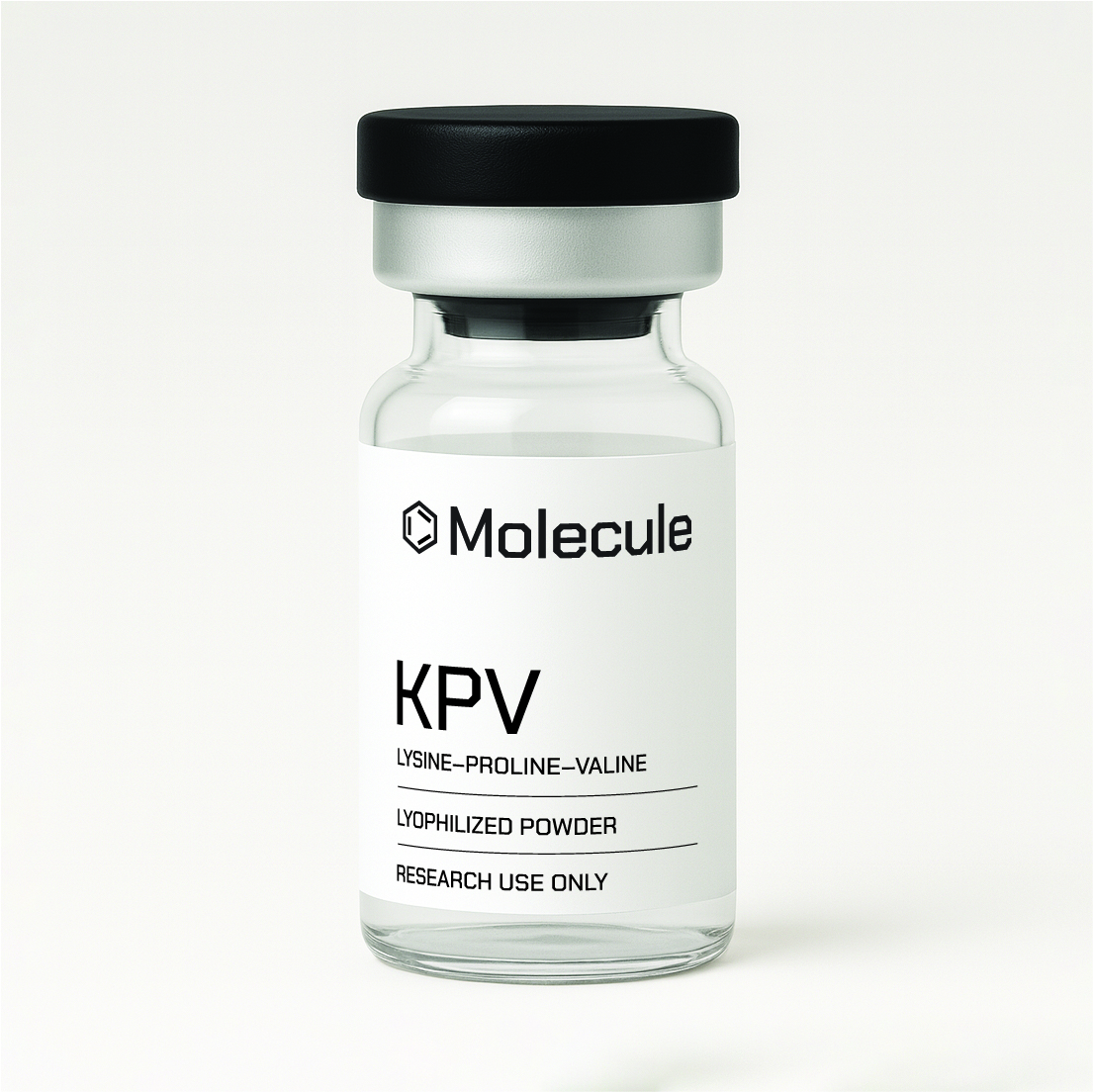
KPV
Synthetic Tripeptide Research Tool
KPV (Lysine–Proline–Valine) is a naturally occurring C-terminal tripeptide fragment derived from the larger α-melanocyte-stimulating hormone (α-MSH). In preclinical and laboratory research, KPV is investigated for its potential interactions with melanocortin receptors and its modulatory effects on inflammatory and immune signaling pathways.
In research contexts, KPV is explored as a bioactive peptide with anti-inflammatory and wound-healing properties in vitro, particularly within epithelial and keratinocyte models. Investigations examine its influence on cytokine production, NF-κB signaling, and immune-cell mediated responses. Research applications remain confined to non-clinical, preclinical laboratory settings.
Peptide Identity and Molecular Profile
| Property |
Description |
| Peptide Name |
KPV |
| Peptide Class |
Synthetic tripeptide, α-MSH C-terminal fragment |
| Amino Acid Length |
3 residues |
| Peptide Sequence |
Lys–Pro–Val |
| Molecular Weight |
341.45 Da |
| Biological Origin |
Derived fragment of endogenous α-MSH |
| Molecular Formula |
C₁₆H₂₈N₄O₄ |
| CAS Number |
81732-46-9 |
| PubChem CID |
3081391 |
| Synonyms |
Lys-Pro-Val, α-MSH (11–13), α-Melanotropin tripeptide |
| Source Notes |
Synthetic, laboratory-grade, research-use peptide |
Biological Pathways Studied (Preclinical Research)
In laboratory research, KPV is studied for its interactions with inflammatory and melanocortin-associated pathways, including:
| Pathway / System |
Research Context |
| Inflammatory Cytokine Modulation |
Investigated for suppression of proinflammatory mediators (e.g., TNF-α, IL-1β) in cellular models |
| NF-κB Signaling Pathway |
Studied for potential inhibitory effects on NF-κB translocation and activity |
| Epithelial Barrier Integrity |
Examined for restorative properties in keratinocyte and mucosal models |
| Melanocortin Receptor Signaling (MC1R) |
Explored for weak agonistic or indirect modulatory interactions |
| Tissue Repair and Regeneration |
Evaluated in preclinical settings for wound healing and epithelial recovery dynamics |
Research Applications
KPV is routinely utilized in preclinical laboratory research for:
-
In vitro analysis of anti-inflammatory signal modulation
-
Studies on epithelial and mucosal tissue physiology
-
Investigation of α-MSH fragment bioactivity and receptor cross-reactivity
-
Research into peptide-based immunomodulatory mechanisms
-
Comparative peptide structure–function relationship studies
Note: KPV is restricted to preclinical research purposes only. It is not intended for human, therapeutic, veterinary, or diagnostic use. All handling must comply with institutional biosafety regulations.
Storage and Handling Guidelines
Store KPV as a lyophilized powder in a cool, dry environment, protected from light. Maintain laboratory-standard peptide storage conditions (≤ –20 °C for long-term stability). Handle using approved laboratory peptide safety procedures.
Lyophilized Form:
KPV is supplied in lyophilized form to ensure molecular stability and accurate mass yield for dosing in research experiments.
After Reconstitution:
Reconstituted KPV should be stored according to laboratory best practices. Stability depends on solvent, pH, and temperature; typically suitable for short-term experimental use.
Compliance Notice
KPV is provided exclusively for laboratory and preclinical research use. It is not approved for human or veterinary applications. Purchasers are responsible for proper storage, handling, and compliance with all institutional and regional regulations governing research peptides.
Overview
KPV is a synthetic tripeptide composed of Lysine–Proline–Valine and represents the C-terminal fragment of alpha-melanocyte-stimulating hormone (α-MSH). In laboratory and preclinical research, KPV is studied as a non-pigmentary melanocortin fragment used to investigate inflammatory signaling, epithelial homeostasis, and immune–neuroendocrine interactions.
Unlike full-length α-MSH analogs, KPV does not stimulate melanogenesis and lacks tanning or pigmentation effects. This property has made KPV a useful research tool for isolating anti-inflammatory and barrier-regulatory mechanisms independent of melanocortin-driven pigmentation pathways (Catania et al., 2010).
KPV is commonly employed in in vitro models, cell culture systems, and animal studies to explore peptide-mediated modulation of cytokine signaling and epithelial integrity.
Molecular Formula: C₁₅H₂₆N₄O₄
Molecular Weight: ~330.4 g/mol
Mechanism of Action in Laboratory Models
KPV is believed to exert its biological effects through melanocortin-independent and melanocortin-associated pathways, depending on experimental context. In laboratory studies, KPV has been investigated for the following mechanisms:
-
Inhibition of pro-inflammatory signaling
KPV has been shown in cell models to suppress activation of NF-κB–related inflammatory pathways and reduce expression of pro-inflammatory cytokines such as TNF-α and IL-6 (Catania et al., 2010).
-
Epithelial barrier modulation
In intestinal and epithelial cell cultures, KPV has been studied for its role in maintaining tight-junction integrity and regulating inflammatory responses at mucosal surfaces.
-
Melanocortin system interaction (non-pigmentary)
While KPV originates from α-MSH, it does not activate melanogenic pathways and is used to differentiate anti-inflammatory signaling from pigmentation-associated receptor activation.
Laboratory assays commonly measure cytokine expression, transcription factor activation, and barrier permeability markers to evaluate KPV’s activity.
Primary Research Findings
Research involving KPV spans cellular biology, immunology, and gastrointestinal research models:
-
Inflammatory Regulation
KPV has demonstrated the ability to reduce inflammatory mediator production in macrophage and epithelial cell cultures, supporting investigation into peptide-based inflammatory modulation (Catania et al., 2010).
-
Gut and Mucosal Research
Preclinical models of intestinal inflammation have employed KPV to study peptide effects on epithelial healing, mucosal immune signaling, and cytokine balance without systemic pigmentation effects.
-
Skin and Barrier Biology
In keratinocyte and skin-related research models, KPV has been examined for its influence on inflammatory signaling and barrier repair mechanisms, independent of melanocyte activation.
These findings are presented in mechanistic and exploratory research contexts and do not imply therapeutic use.
System-Specific Research Applications
Inflammation and Immune Signaling
Laboratory research often focuses on:
Gastrointestinal and Epithelial Research
Preclinical studies investigate:
-
Intestinal epithelial barrier integrity
-
Mucosal inflammation models
-
Peptide effects on epithelial repair pathways
Skin and Barrier Function Research
Experimental models examine:
-
Keratinocyte inflammatory responses
-
Non-pigmentary α-MSH fragment activity
-
Barrier homeostasis signaling
Comparative Research Context
KPV is frequently studied alongside full-length α-MSH peptides and other melanocortin fragments to distinguish pigmentary versus non-pigmentary signaling pathways. Comparative research emphasizes receptor selectivity, peptide length, and functional specificity rather than efficacy or clinical relevance.
Research Handling and Format
-
Lyophilized Powder – KPV is typically supplied as a freeze-dried powder to support stability and reproducibility in laboratory protocols.
-
Storage Recommendations – Store in a cool, dry environment, protected from light and moisture.
-
Experimental Preparation – Reconstitution should be performed under sterile laboratory conditions. Post-reconstitution stability may vary and should be evaluated during experimental design.
Research Use Only Disclaimer
This compound is intended solely for laboratory research purposes.
Not for human consumption, clinical use, therapeutic application, or veterinary use.
All handling and experimentation must comply with applicable institutional, ethical, and regulatory guidelines.
References
Catania, A., Gatti, S., Colombo, G., & Lipton, J. M. (2010).
Anti-inflammatory actions of melanocortin peptides in experimental models. Pharmacology & Therapeutics, 125(1), 36–47.
https://doi.org/10.1016/j.pharmthera.2009.10.004
Lipton, J. M., & Catania, A. (1997).
Anti-inflammatory actions of the neuroimmunomodulator α-MSH. Immunology Today, 18(3), 140–145.
https://doi.org/10.1016/S0167-5699(97)01004-1