Description
PT-141 (Bremelanotide)
PT-141 (Bremelanotide) is a synthetic cyclic peptide derived from modifications of the melanocortin peptide family, particularly analogs of α-melanocyte-stimulating hormone (α-MSH). It is widely utilized in laboratory and preclinical research investigating melanocortin receptor signaling, neuroendocrine regulation, and central nervous system pathways.
The peptide belongs to a class of compounds known as melanocortin receptor agonists, which interact with receptor subtypes expressed throughout the central nervous system and peripheral tissues. In experimental research settings, PT-141 has been studied primarily for its activity at melanocortin receptor subtypes MC3R and MC4R, which are involved in complex regulatory networks including neuroendocrine signaling and autonomic physiological processes.
Due to its receptor selectivity and stable cyclic structure, PT-141 is frequently used in pharmacological and receptor-binding studies designed to investigate melanocortin pathway activity and downstream intracellular signaling mechanisms. Preclinical research has explored how melanocortin receptor activation influences hypothalamic signaling pathways, neurotransmitter systems, and regulatory neuropeptide networks.
Rather than targeting a single isolated biological process, PT-141 is studied as part of broader melanocortin system research, where investigators examine interactions among receptor activation, intracellular signaling cascades, and neuroendocrine regulatory circuits.
Peptide Identity and Molecular Profile
| Property |
Description |
| Peptide Name |
PT-141 |
| Full Name |
Bremelanotide |
| Peptide Class |
Synthetic cyclic melanocortin peptide |
| Amino Acid Length |
7 residues (cyclic heptapeptide) |
| Peptide Sequence |
Ac-Nle-c[Asp-His-D-Phe-Arg-Trp-Lys]-OH |
| Molecular Weight |
~1,025 Da |
| Biological Origin |
Synthetic analog derived from α-MSH melanocortin peptides |
Chemical and Registry Information
| Property |
Value |
| Molecular Formula |
C₅₀H₆₈N₁₄O₁₀ |
| CAS Number |
189691-06-3 |
| PubChem CID |
5282413 |
| Synonyms |
Bremelanotide, PT-141, Melanocortin receptor agonist |
Biological Pathways Studied (Preclinical Research)
In laboratory and preclinical research environments, PT-141 has been investigated for interactions with melanocortin receptor signaling pathways and associated neuroendocrine systems. These studies examine molecular and cellular mechanisms rather than clinical outcomes.
| Pathway / System |
Research Context |
| Melanocortin Receptor Signaling |
Investigated for activation of MC3R and MC4R receptor subtypes |
| cAMP Signaling Pathways |
Studied for receptor-mediated intracellular signaling cascades |
| Neuroendocrine Regulation |
Examined within hypothalamic regulatory networks |
| Central Nervous System Pathways |
Explored in melanocortin-related neuronal signaling models |
| Neurotransmitter Systems |
Investigated in dopaminergic and autonomic signaling research |
Research Applications
PT-141 is commonly used in laboratory research involving:
• Melanocortin receptor pharmacology
• Neuroendocrine signaling pathway studies
• Hypothalamic regulatory network research
• Central nervous system receptor signaling investigations
• Comparative melanocortin peptide studies
Storage and Handling Guidelines
Store PT-141 in a cool, dry environment protected from light to maintain peptide stability. Appropriate laboratory storage conditions should be maintained to preserve molecular integrity. Handle all research peptides according to standard laboratory safety protocols.
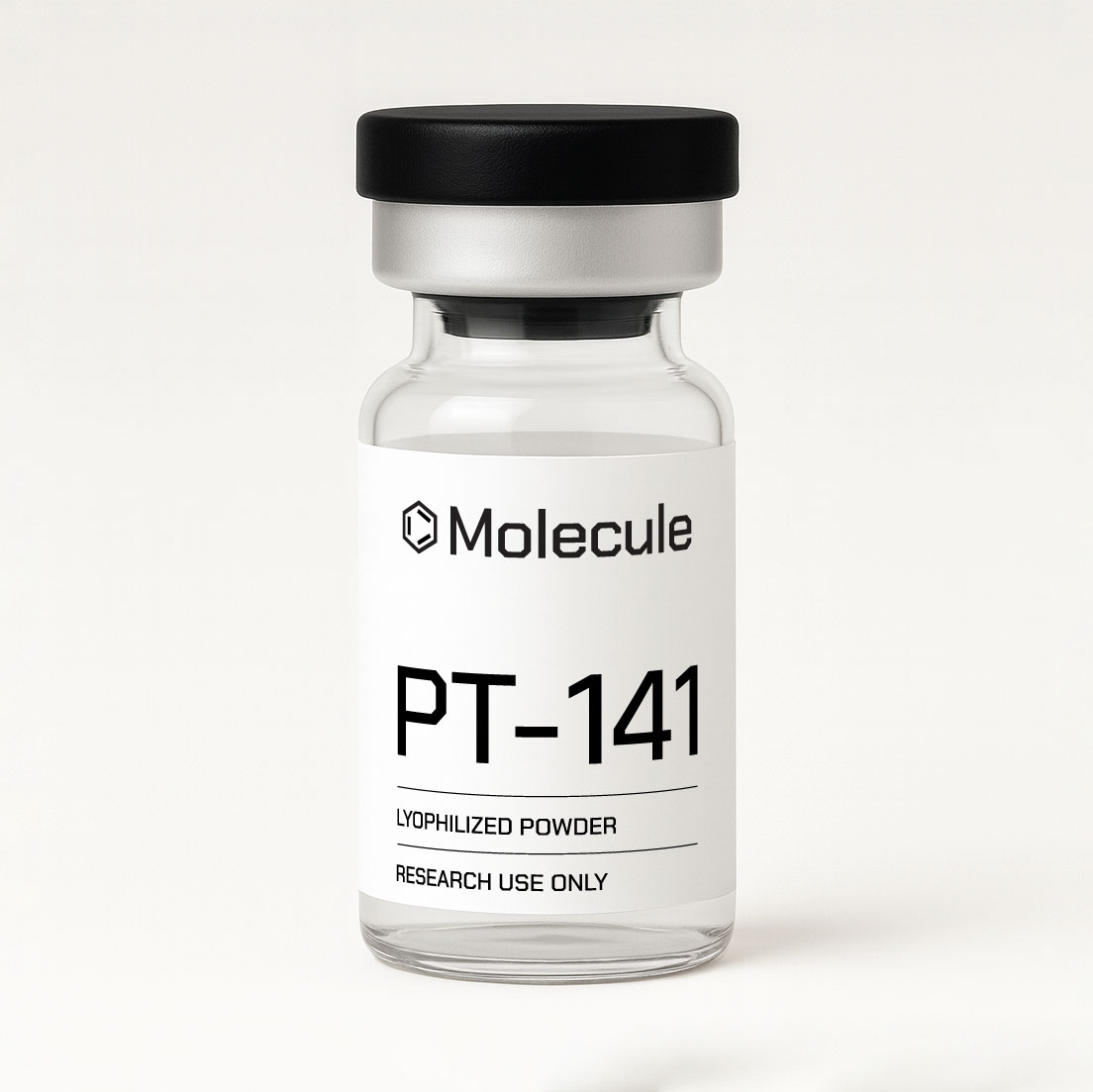
Lyophilized Powder
PT-141 is supplied in lyophilized powder form, produced through freeze-drying to remove residual moisture while preserving peptide conformation and chemical stability. This format supports accurate measurement and reproducibility in controlled experimental research protocols.
Shelf Life After Reconstitution
Once reconstituted, PT-141 is no longer in its lyophilized state, and its stability characteristics differ from those of the dry powder. In laboratory environments, reconstituted peptide materials are typically considered to have a short-term usable shelf life, commonly measured in days rather than weeks, depending on experimental conditions.
Proper handling, storage temperature, and sterility protocols are important factors influencing peptide stability following reconstitution. Researchers commonly incorporate these considerations into experimental design and quality control procedures.
PT-141 Research Overview
PT-141 (Bremelanotide) is a synthetic melanocortin receptor agonist peptide derived from the α-melanocyte-stimulating hormone (α-MSH) analog Melanotan II. It consists of a cyclic heptapeptide structure with the sequence Ac-Nle-c[Asp-His-D-Phe-Arg-Trp-Lys]-OH, molecular weight approximately 1,025 Da, and molecular formula C₅₀H₆₈N₁₄O₁₀.
In laboratory settings, PT-141 is utilized in neuroendocrine, melanocortin receptor, and central nervous system signaling research, particularly involving melanocortin receptor subtypes MC3R and MC4R. These receptors are widely studied for their roles in hypothalamic signaling pathways, neuropeptide regulation, and autonomic responses.
Preclinical and in vitro investigations focus on melanocortin receptor activation, central neurotransmitter modulation, and neuroendocrine signaling pathways. PT-141 is therefore primarily examined as a tool compound in melanocortin system research.
Note: All mechanistic insights derive from laboratory or animal models. PT-141 is supplied for research-use-only and is not intended for human or veterinary application.
Mechanism of Action in Laboratory Models
PT-141 has been investigated across several preclinical signaling pathways related to melanocortin receptor activity.
Melanocortin Receptor Activation
PT-141 functions as an agonist of melanocortin receptors, particularly MC3R and MC4R, which are expressed in hypothalamic and limbic brain regions.
Laboratory studies examine receptor binding affinity and downstream signaling cascades involving adenylate cyclase activation and cyclic AMP (cAMP) signaling (Hadley & Haskell-Luevano, 1999).
Neuroendocrine Signaling
Experimental models investigate melanocortin-mediated regulation of hypothalamic neuropeptides, including pathways influencing dopaminergic and autonomic signaling networks.
These signaling cascades are commonly evaluated in rodent CNS models and receptor-binding assays.
Central Nervous System Modulation
PT-141 is studied for its activity within the central melanocortin system, particularly within hypothalamic regions that regulate autonomic and behavioral signaling processes.
Laboratory assays often examine neuronal activation markers, neurotransmitter release, and receptor-mediated intracellular signaling pathways.
Melanocortin Pathway Regulation
The melanocortin system is involved in multiple physiological regulatory networks, including:
- neuroendocrine signaling
- metabolic regulation
- autonomic nervous system activity
PT-141 is used experimentally to explore how melanocortin receptor activation influences these pathways in controlled research settings.
Primary Research Findings
Preclinical and laboratory studies investigating PT-141 have focused on receptor pharmacology and neuroendocrine signaling.
Melanocortin Receptor Pharmacology
Binding studies demonstrate that PT-141 exhibits strong agonist activity at MC4R, a receptor implicated in hypothalamic signaling and autonomic regulation (Martin et al., 2002).
These assays typically evaluate receptor activation using cAMP accumulation assays and receptor-binding experiments.
Central Neural Signaling
Laboratory models investigating central melanocortin pathways examine neuronal activity markers within the hypothalamus and limbic structures.
These studies analyze neuropeptide release and neural signaling responses following melanocortin receptor activation.
Neuroendocrine Pathway Research
Research involving melanocortin signaling examines how receptor activation influences neurotransmitter systems and autonomic responses within controlled experimental models.
These investigations contribute to broader understanding of melanocortin system physiology.
Note: Observed effects represent mechanistic observations in controlled laboratory environments. Direct clinical translation is not established.
Research Applications
Melanocortin Receptor Studies
PT-141 is frequently used in receptor pharmacology research investigating MC3R and MC4R signaling.
Laboratory assays evaluate receptor binding, intracellular signaling, and downstream neuroendocrine responses.
Neuroendocrine Research
Studies examine the interaction between melanocortin signaling pathways and hypothalamic neuropeptide systems, contributing to broader research on CNS regulatory networks.
Central Nervous System Signaling
Experimental models utilize PT-141 to investigate central melanocortin pathway activation, particularly within hypothalamic circuits.
Comparative Peptide Research
PT-141 is often evaluated alongside other melanocortin peptides, including α-MSH analogs and Melanotan derivatives, to examine receptor specificity and signaling differences.
Comparative Research Context
PT-141 is commonly studied in comparison with other melanocortin receptor ligands, including:
- Melanotan I (Afamelanotide)
- Melanotan II
- α-MSH analog peptides
Comparative laboratory studies focus on receptor-binding affinity, signaling potency, and receptor subtype selectivity rather than functional superiority.
Research remains limited to in vitro assays and animal models.
Research Handling and Format
Lyophilized Powder:
Provided in freeze-dried form to support chemical stability and experimental reproducibility.
Storage:
Maintain in a cool, dry environment protected from light.
Reconstitution:
Stability following reconstitution depends on laboratory conditions and storage parameters.
Research Use Only:
This compound is intended solely for laboratory research applications.
Peptide Identity and Molecular Profile
| Property |
Description |
| Peptide Name |
PT-141 (Bremelanotide) |
| Peptide Class |
Synthetic melanocortin receptor agonist |
| Amino Acid Sequence |
Ac-Nle-c[Asp-His-D-Phe-Arg-Trp-Lys]-OH |
| Amino Acid Length |
7 residues (cyclic) |
| Molecular Weight |
~1,025 Da |
| Molecular Formula |
C₅₀H₆₈N₁₄O₁₀ |
| Research Role |
Laboratory studies on melanocortin receptor signaling and neuroendocrine pathways |
References
Hadley, M. E., & Haskell-Luevano, C. (1999). The proopiomelanocortin system. Annals of the New York Academy of Sciences, 885, 1–21.
https://doi.org/10.1111/j.1749-6632.1999.tb08658.x
Martin, W. J., McGowan, E., Cashen, D. E., et al. (2002). Activation of melanocortin receptors by PT-141 in preclinical models. Journal of Pharmacology and Experimental Therapeutics, 300(2), 500–508.
https://doi.org/10.1124/jpet.300.2.500
Cone, R. D. (2005). Anatomy and regulation of the central melanocortin system. Nature Neuroscience, 8(5), 571–578.
https://doi.org/10.1038/nn1455
Millington, G. W. M. (2007). The role of proopiomelanocortin (POMC) neurons in feeding behaviour. Nutrition & Metabolism, 4(1), 18.
https://doi.org/10.1186/1743-7075-4-18
Note: Current understanding of PT-141 derives primarily from mechanistic, pharmacological, and preclinical studies. Clinical outcomes and therapeutic applications are outside the scope of laboratory research descriptions.