Description
ARA-290 (Cibinetide)
ARA-290 (Cibinetide) is a synthetic peptide derived from the tertiary structure of erythropoietin (EPO), designed to mimic specific signaling regions associated with tissue-protective receptor pathways. It is widely utilized in laboratory and preclinical research investigating innate repair receptor (IRR) signaling, inflammatory pathway regulation, and cellular stress response mechanisms.
The peptide is composed of 11 amino acids and is structurally designed to selectively engage the innate repair receptor complex, a heteromeric receptor system formed by the erythropoietin receptor (EPOR) and the β-common receptor (CD131). In experimental research settings, ARA-290 has been studied for its involvement in cellular protective signaling, inflammatory pathway modulation, and neuroimmune communication mechanisms.
Due to its receptor specificity and defined signaling profile, ARA-290 is frequently used in cell culture and preclinical research models examining tissue response pathways following cellular stress, inflammatory stimuli, and metabolic disruption. Laboratory investigations have explored how activation of innate repair receptor signaling may influence cytokine pathways, cellular resilience mechanisms, and neuroimmune signaling networks.
Rather than acting through broad erythropoietic signaling pathways, ARA-290 is studied for its selective engagement of tissue-protective receptor systems, making it a compound of ongoing interest in research exploring coordinated cellular repair and inflammatory regulation mechanisms.
Peptide Identity and Molecular Profile
| Property |
Description |
| Peptide Name |
ARA-290 |
| Full Name |
Cibinetide |
| Peptide Class |
Synthetic erythropoietin-derived peptide |
| Amino Acid Length |
11 residues |
| Peptide Sequence |
QEQLERALNSS |
| Molecular Weight |
~1,257 Da |
| Biological Origin |
Synthetic analog derived from erythropoietin receptor-binding region |
Chemical and Registry Information
| Property |
Value |
| Molecular Formula |
C₅₁H₈₄N₁₆O₂₁ |
| CAS Number |
1208243-50-8 |
| PubChem CID |
25243978 |
| Synonyms |
Cibinetide, ARA-290, EPO-derived peptide |
Biological Pathways Studied (Preclinical Research)
In laboratory and preclinical research environments, ARA-290 has been investigated for interactions with several biological signaling pathways related to cellular protection and inflammatory signaling.
| Pathway / System |
Research Context |
| Innate Repair Receptor (IRR) Signaling |
Studied in relation to EPOR-CD131 receptor complex activation |
| Cytokine Signaling Pathways |
Investigated for roles in inflammatory signaling modulation |
| Neuroimmune Communication |
Explored in cellular stress and neuroinflammation models |
| Cellular Stress Response |
Examined in pathways associated with metabolic and inflammatory stress |
Research Applications
ARA-290 is commonly used in laboratory research involving:
• Neuroimmune signaling studies
• Cellular stress and inflammatory pathway research
• Innate repair receptor signaling investigations
• Cytokine pathway analysis
• Cellular protection mechanisms in experimental models
Storage and Handling Guidelines
Store ARA-290 in a cool, dry environment protected from light to maintain peptide stability. Appropriate laboratory storage conditions should be maintained to preserve molecular integrity. Handle all research peptides using standard laboratory safety protocols.
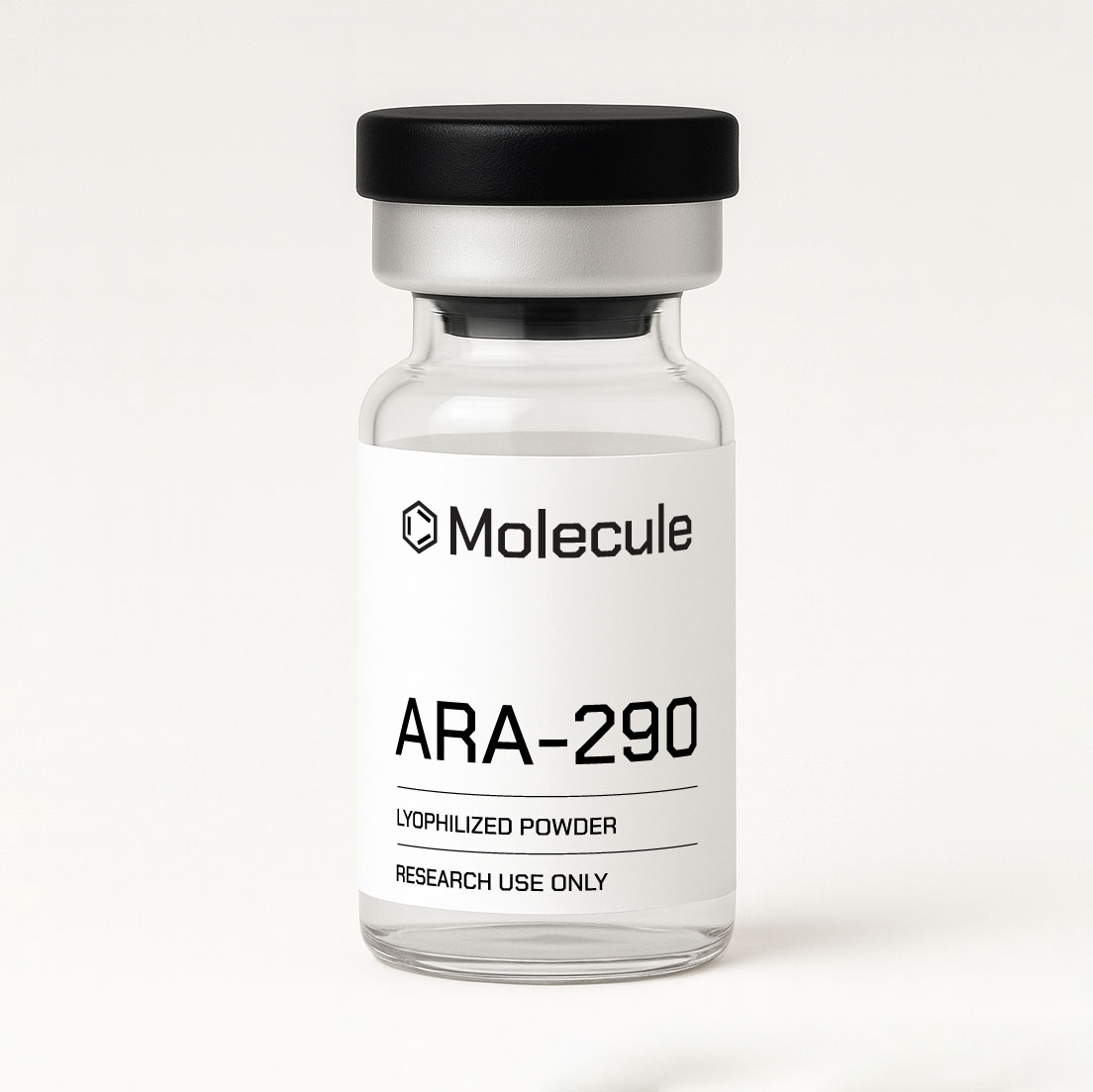
Lyophilized Powder
ARA-290 is supplied in lyophilized powder form, produced through freeze-drying to remove residual moisture while preserving peptide conformation and chemical stability. This format supports accurate measurement and reproducibility in controlled laboratory research protocols.
Shelf Life After Reconstitution
Once reconstituted, ARA-290 is no longer in its lyophilized state, and its stability characteristics differ from those of the dry powder. In laboratory research environments, reconstituted peptide material is generally regarded as having a short-term usable shelf life, commonly measured in days rather than weeks depending on experimental conditions.
Researchers typically account for post-reconstitution stability as part of experimental planning and quality control procedures. Stability may vary depending on storage conditions and laboratory protocols.
ARA-290 Research Overview
ARA-290 (Cibinetide) is a synthetic peptide derived from the tertiary structure of erythropoietin (EPO) designed to mimic specific signaling domains associated with tissue-protective receptor pathways. The peptide consists of 11 amino acids with sequence QEQLERALNSS, molecular weight approximately 1,257 Da, and molecular formula C₅₁H₈₄N₁₆O₂₁.
In laboratory and preclinical research environments, ARA-290 is utilized to investigate innate repair receptor (IRR) signaling, inflammatory pathway modulation, and cellular stress response mechanisms. Experimental studies examine how selective engagement of the erythropoietin receptor (EPOR)–β common receptor (CD131) heteromeric complex influences intracellular signaling pathways associated with tissue-protective responses.
Unlike erythropoietin itself, ARA-290 is studied for its ability to selectively activate non-erythropoietic receptor signaling pathways in cellular and animal models. Laboratory investigations have explored its activity across neuronal, endothelial, and immune cell systems, emphasizing receptor-mediated signaling mechanisms rather than therapeutic outcomes.
Note: All mechanistic insights derive from laboratory or animal models. This compound is research-use only and not intended for human or veterinary application.
Mechanism of Action in Laboratory Models
ARA-290 has been investigated in several preclinical cellular signaling pathways.
Innate Repair Receptor (IRR) Activation
Laboratory models examine selective activation of the EPOR-CD131 receptor complex, known as the innate repair receptor. Receptor-binding and signaling assays evaluate downstream intracellular signaling responses (Brines et al., 2008).
Cytokine and Inflammatory Signaling
Experimental studies investigate modulation of pro-inflammatory cytokine signaling pathways, including cellular models examining inflammatory mediator expression and immune signaling regulation.
Neuroimmune Signaling
Preclinical models explore interactions with neuroimmune communication pathways, including neuronal and glial signaling responses associated with cellular stress conditions.
Cellular Stress Response Pathways
Laboratory assays examine signaling mechanisms related to cellular protection, mitochondrial function, and metabolic stress responses, particularly in models of tissue injury or inflammatory challenge.
Primary Research Findings
Mechanistic studies in preclinical and in vitro models demonstrate several areas of investigation.
Innate Repair Signaling
Research involving receptor-binding assays and cellular models evaluates activation of the EPOR-CD131 receptor complex and associated intracellular signaling pathways (Brines et al., 2008).
Neuroimmune Communication
Laboratory models investigating neuronal and immune cell signaling examine how ARA-290 interacts with neuroimmune signaling networks and inflammatory response pathways.
Cellular Stress Pathways
Experimental systems studying metabolic or inflammatory stress examine receptor-mediated signaling associated with cellular resilience and repair-related pathways.
Note: Reported effects represent mechanistic observations in laboratory research; direct clinical translation is not established.
Research Applications
Neuroimmune Signaling Research
Investigations include neuronal–immune communication pathways and cellular stress response signaling.
Inflammatory Pathway Studies
Laboratory models examine cytokine signaling, inflammatory mediator regulation, and immune signaling pathways.
Cellular Stress and Repair Signaling
Research explores signaling mechanisms associated with cellular adaptation and tissue response pathways following experimental stress conditions.
Comparative Research Context
ARA-290 is frequently evaluated in comparison with erythropoietin-derived peptides and tissue-protective cytokine signaling molecules.
Comparative research focuses on receptor signaling specificity and intracellular pathway activation in vitro or in animal models rather than functional superiority.
Research Handling and Format
Lyophilized Powder: Provided freeze-dried to support chemical stability and reproducibility.
Storage: Maintain in a cool, dry, light-protected environment.
Reconstitution: Stability post-reconstitution is short-term and laboratory-condition dependent.
Research Use Only: Intended solely for laboratory research purposes.
Peptide Identity and Molecular Profile
| Property |
Description |
| Peptide Name |
ARA-290 |
| Peptide Class |
Synthetic erythropoietin-derived peptide |
| Amino Acid Sequence |
QEQLERALNSS |
| Amino Acid Length |
11 residues |
| Molecular Weight |
~1,257 Da |
| Molecular Formula |
C₅₁H₈₄N₁₆O₂₁ |
| Research Role |
Preclinical studies on innate repair receptor signaling, inflammatory pathways, and cellular stress responses |
References
Brines, M., Patel, N. S. A., Villa, P., et al. (2008). Nonerythropoietic derivatives of erythropoietin reduce tissue injury and inflammation. Proceedings of the National Academy of Sciences, 105(31), 10925–10930.
https://doi.org/10.1073/pnas.0805594105
Brines, M., & Cerami, A. (2012). The receptor that tames the innate immune response. Molecular Medicine, 18, 486–496.
https://doi.org/10.2119/molmed.2012.00005
Brines, M., et al. (2004). Erythropoietin crosses the blood–brain barrier to protect against experimental brain injury. PNAS, 101(37), 13628–13633.
https://doi.org/10.1073/pnas.0405520101
Note: Current understanding of ARA-290 derives primarily from mechanistic and preclinical studies. Clinical outcomes remain outside the scope of laboratory research descriptions.