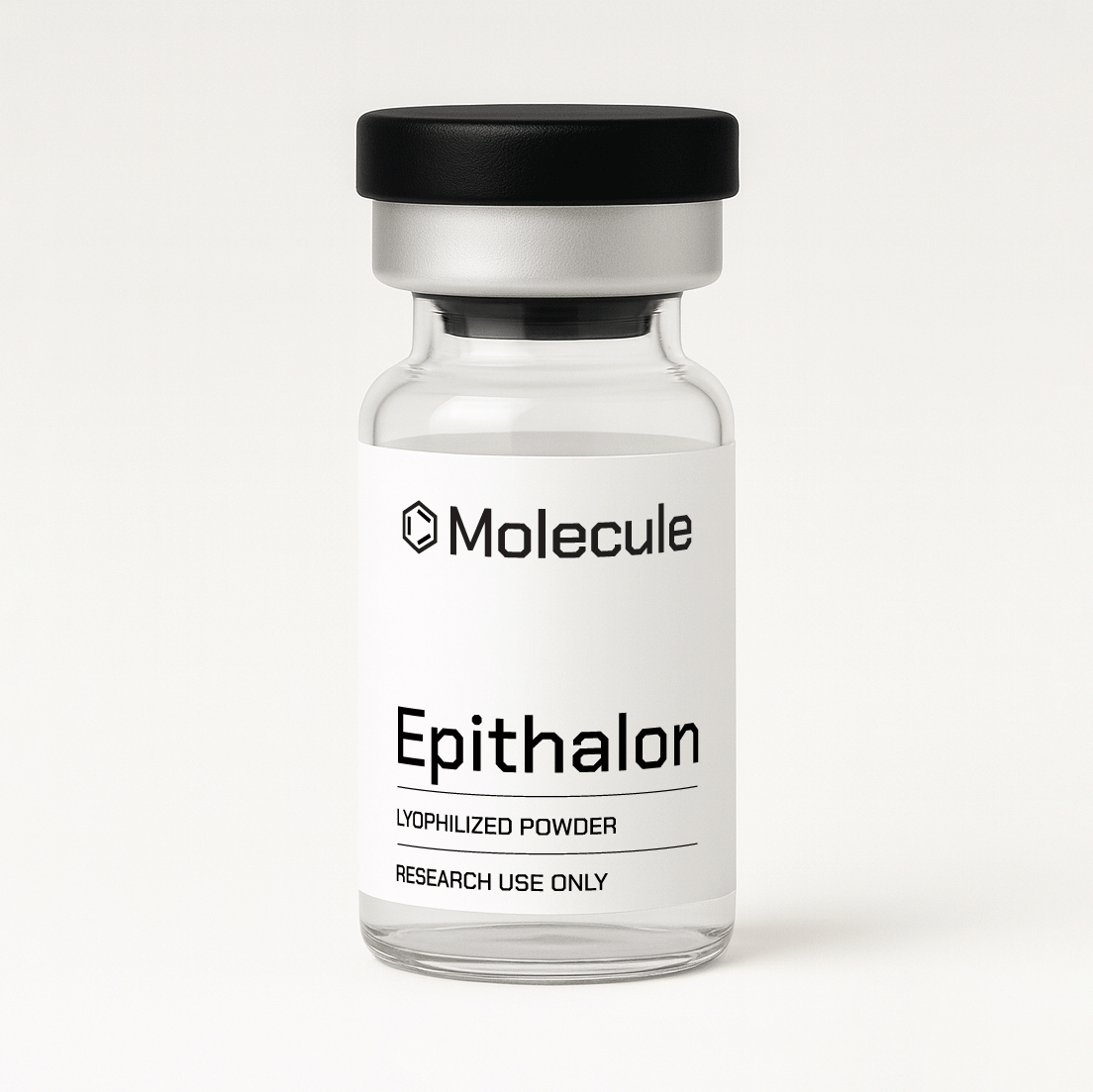
Epitalon

Epitalon is a synthetic peptide that may support cellular health, longevity, and healthy aging processes.

Price range: $75.00 through $150.00

Size

Fast processing & shipping

Orders are processed and shipped within 1–2 business days to ensure timely delivery of research materials.

All sales final

Due to the nature of laboratory research materials, all sales are final once shipped. No returns or refunds on delivered items.

Limited refund eligibility

Refunds or replacements are only issued for incorrect, damaged, or undelivered orders. Claims must be submitted within 48 hours with supporting photos.

Description

Epitalon (Epithalon)

Synthetic Tetrapeptide (Epitalamic Peptide Analog)

Epitalon, also known in the research literature as Epitalon, is a synthetic tetrapeptide originally developed as an analog of peptides derived from the epithalamic region. In laboratory and preclinical research settings, Epitalon is used as a research tool to investigate cellular aging mechanisms, chromosomal stability, and regulatory signaling associated with circadian and neuroendocrine systems.

In experimental models, Epitalon has been explored for its interactions with telomere-associated processes, DNA regulatory pathways, and transcriptional signaling networks. Its short peptide length and simple structure allow for focused investigation of intracellular peptide activity, nuclear signaling interactions, and peptide–DNA interface studies under controlled conditions.

Rather than acting as a hormone or growth factor, Epitalon is studied for its regulatory role in cellular signaling and genomic maintenance pathways, making it relevant to preclinical research on cellular senescence, replication limits, and long-term cellular regulation mechanisms.


Peptide Identity and Molecular Profile

Property Description
Peptide Name Epitalon
Alternate Name Epithalon
Peptide Class Synthetic tetrapeptide
Amino Acid Length 4 residues
Peptide Sequence Ala-Glu-Asp-Gly
Molecular Weight ~390 Da (may vary by synthesis and salt form)
Primary Research Focus Cellular aging and genomic regulation pathways

Chemical and Registry Information

Property Value
Molecular Formula Reported in research literature; may vary by salt form
CAS Number 307297-39-8 (reported in research literature)
Registry Identifiers Research designation: Epitalon
Synonyms Epithalon, AEDG peptide
Structural Features Linear tetrapeptide

Biological Pathways Studied (Preclinical Research)

In laboratory and preclinical research environments, Epitalon has been studied for its interactions with cellular regulatory and genomic maintenance systems. Research emphasizes molecular and intracellular mechanisms rather than physiological or clinical outcomes.

Pathway / System Research Context
Telomere-Associated Pathways Studied for interactions with telomerase-related processes
DNA Transcription Regulation Explored in gene expression and chromatin organization models
Circadian Signaling Networks Investigated in cellular rhythm regulation studies
Neuroendocrine Regulatory Systems Examined in epithalamic signaling research models
Cell Cycle Regulation Studied in replication and senescence-related pathways

Research Applications

Epitalon is commonly used in laboratory research involving:

  • Cellular senescence and replication studies

  • Telomere biology research models

  • Gene expression and chromatin regulation investigations

  • Circadian and neuroendocrine signaling studies

  • Comparative analysis of short regulatory peptides

All applications are restricted to preclinical, in vitro, or animal research contexts.


Storage and Handling Guidelines

Epitalon should be stored under controlled laboratory conditions in a cool, dry environment and protected from light. Standard laboratory safety and peptide-handling procedures should be followed to maintain chemical stability and experimental reproducibility.


Lyophilized Powder

Epitalon is supplied as a lyophilized powder, produced through freeze-drying to remove residual moisture while preserving peptide structure and chemical integrity. This format supports extended storage stability, accurate measurement, and consistent preparation across experimental protocols.


Shelf Life After Reconstitution

Once reconstituted, Epitalon is no longer in its lyophilized state, and stability characteristics depend on buffer composition, temperature, handling frequency, and study duration. In research environments, reconstituted peptide material is typically regarded as suitable for short-term experimental use, with post-reconstitution stability considered during protocol development and data-integrity planning. Actual usable time frames vary based on laboratory-specific conditions.

Epitalon Research Overview

Epitalon (also referred to as Epitalon or Ala-Glu-Asp-Gly) is a synthetic tetrapeptide derived from studies of naturally occurring pineal peptides. In preclinical and in vitro research, Epitalon is investigated for its potential regulatory effects on cellular senescence, telomerase activity, and age-associated molecular pathways, rather than for any therapeutic or clinical application.

Laboratory studies focus on Epitalon as a tool to explore peptide-mediated modulation of cellular aging processes, nuclear signaling, and cell cycle regulation. Its simple sequence and chemical stability facilitate controlled experimental investigations.


Mechanism of Action in Laboratory Models

Preclinical and in vitro studies suggest Epitalon may act through mechanistic pathways associated with cellular aging and nuclear regulation:

  • Telomerase Modulation

    • Investigated for effects on telomerase activity in cultured somatic cells (Khavinson et al., 2003).

  • Cell Cycle and Senescence Regulation

    • Explored in fibroblast and epithelial cell models to examine replicative senescence markers such as telomere length and senescence-associated β-galactosidase activity.

  • Nuclear Signaling Effects

    • Studied for potential modulation of gene expression associated with aging, though independent replication beyond the Khavinson group remains limited.

Note: Most mechanistic findings are limited to early preclinical research, and detailed molecular targets are under investigation.


Primary Research Observations

In laboratory studies, Epitalon has been investigated for cellular and molecular endpoints related to aging:

  • Telomerase Activity

    • Reported to increase telomerase enzyme activity in cultured human fibroblasts (Khavinson et al., 2003).

  • Senescence Markers

    • Preclinical research indicates delayed onset of senescence-associated markers in cell lines subjected to repeated passage or stress (Khavinson & Morozov, 2009).

  • Comparative Context

    • Epitalon is studied alongside other pineal-derived peptides to explore differential effects on telomerase and cell cycle pathways.

Note: Findings are primarily from the Khavinson research group; independent replication is limited.


System-Specific Research Applications

Cellular Senescence Research

  • Explored in vitro for telomerase activation, nuclear signaling, and chromatin stabilization.

  • Laboratory endpoints include telomere length measurements, proliferative capacity, and senescence-associated biomarkers.

Age-Associated Molecular Pathway Research

  • Investigated for potential regulatory effects on DNA repair, oxidative stress responses, and cell cycle regulation.

  • Focus remains on mechanistic studies rather than clinical or therapeutic outcomes.


Research Handling and Format

  • Lyophilized Powder: Supplied as a freeze-dried peptide, allowing precise reconstitution and experimental control.

  • Storage Guidelines: Maintain in a cool, dry, light-protected environment. Reconstituted peptide stability is variable and laboratory-condition dependent.

  • Research Use Only: Epitalon is intended solely for in vitro or preclinical research, and not for human consumption, clinical, or therapeutic use.


Compound Identity and Molecular Profile

Property Description
Peptide Name Epitalon
Peptide Class Synthetic tetrapeptide
Amino Acid Sequence Ala-Glu-Asp-Gly
Amino Acid Length 4 residues
Molecular Weight ~390 Da
Molecular Formula C₁₄H₂₂N₄O₉
Research Role Laboratory investigations of telomerase activity, senescence modulation, and nuclear regulatory pathways

References

Note: Mechanistic and preclinical investigations of Epitalon are primarily reported by the Khavinson group; independent replication remains limited.

Epitalon COA

Related products

Disclaimer: For Research Purposes Only

The owner of this website has made a commitment to accessibility and inclusion, please report any problems that you encounter using the contact form on this website. This site uses the WP ADA Compliance Check plugin to enhance accessibility.
0
    0
    Your Cart
    Your cart is emptyReturn to Shop