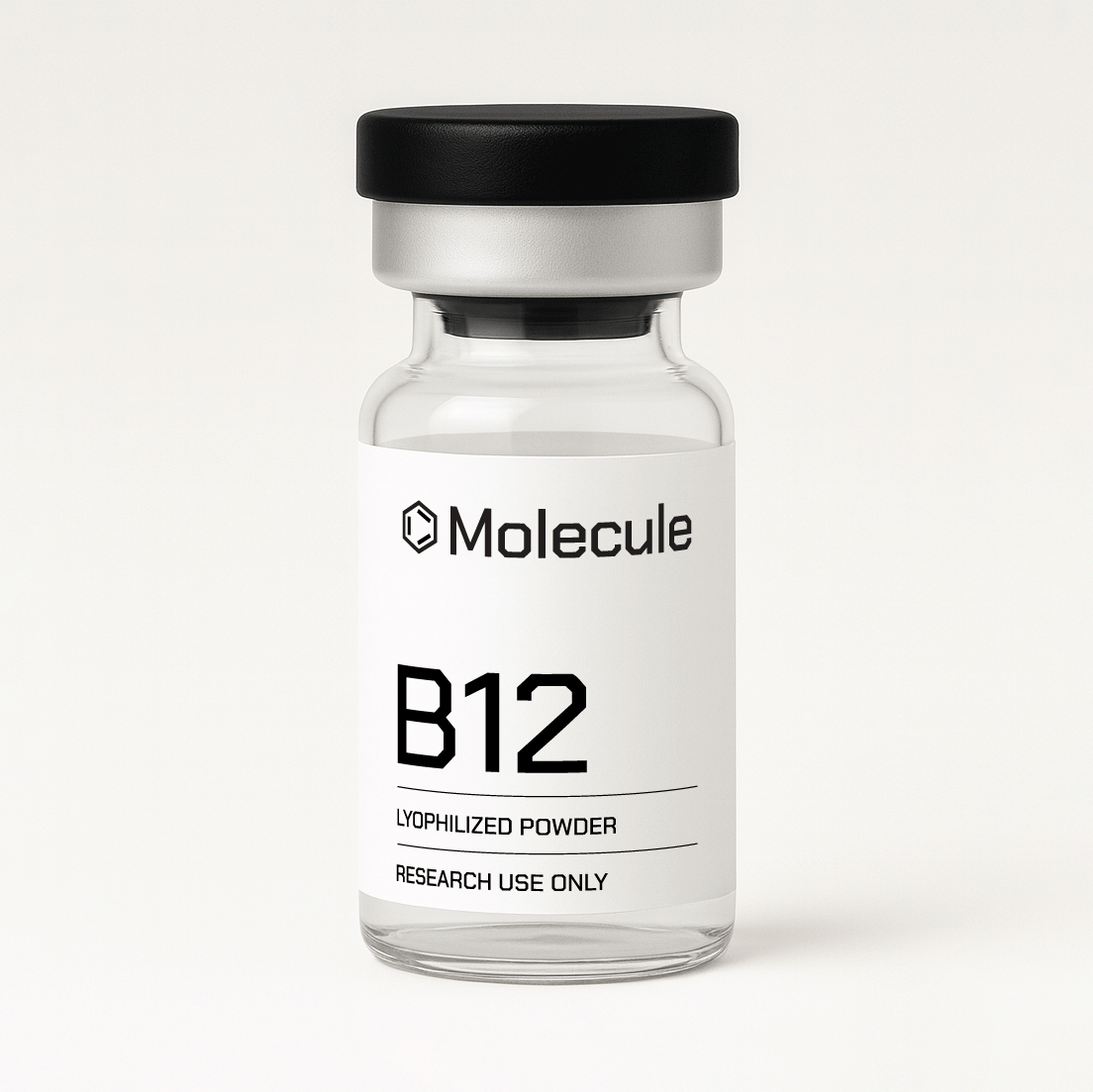
B12

Vitamin B12 (Cobalamin) is an essential vitamin that may support energy production, nervous system health, and red blood cell formation. Available in 10ml size.

$90.00

Size

80mg

Fast processing & shipping

Orders are processed and shipped within 1–2 business days to ensure timely delivery of research materials.

All sales final

Due to the nature of laboratory research materials, all sales are final once shipped. No returns or refunds on delivered items.

Limited refund eligibility

Refunds or replacements are only issued for incorrect, damaged, or undelivered orders. Claims must be submitted within 48 hours with supporting photos.

Description

Vitamin B12 (Cobalamin)

Water-Soluble Cofactor and Enzyme Modulator

Vitamin B12 (Cobalamin) is a water-soluble cobalt-containing compound that functions as a cofactor for enzymatic reactions in cellular metabolism. In laboratory and preclinical research, B12 is primarily studied as a biochemical tool to investigate methylation pathways, mitochondrial function, and intermediary metabolism.

B12 is a well‑established therapeutic vitamin in human and veterinary medicine. Experimental studies have explored B12’s role in methionine synthesis, homocysteine metabolism, and methylmalonyl-CoA conversion, as well as its involvement in cellular energy regulation and redox homeostasis. B12 is widely used in research on metabolic pathways, neurobiochemistry, and enzyme-catalyzed reactions, rather than for direct therapeutic outcomes.


Compound Identity and Molecular Profile

Property Description
Compound Name Vitamin B12
Full Name Cobalamin
Compound Class Water-soluble cofactor, enzyme modulator
Molecular Weight ~1,355 Da (varies by derivative)
Molecular Formula C₆₃H₈₈CoN₁₄O₁₄P
Primary Research Focus Methylation reactions, mitochondrial metabolism, enzymatic cofactor studies

Chemical and Registry Information

Property Value
CAS Number 68-19-9 (Cyanocobalamin)
PubChem CID 5280795
Synonyms Cyanocobalamin, Hydroxocobalamin, Methylcobalamin, Adenosylcobalamin
Structural Features Corrin ring with central cobalt atom; multiple biologically active forms

Biological Pathways Studied (Preclinical Research)

Vitamin B12 has been investigated for mechanistic activity within metabolic and enzymatic pathways:

Pathway / System Research Context
One-Carbon Metabolism Studied as a cofactor in methionine synthase–dependent methylation reactions
Methylmalonyl-CoA Conversion Explored in mitochondrial enzyme-mediated conversion to succinyl-CoA
Homocysteine Metabolism Investigated in enzymatic regulation of homocysteine levels
Neurochemical Pathways Examined for involvement in neuron-associated metabolic pathways in preclinical models
Energy and Redox Regulation Explored in cellular energy metabolism and mitochondrial function studies

Research Applications

Vitamin B12 is commonly used in laboratory research for:

  • Preclinical investigations of methylation and one-carbon pathways

  • Studies of mitochondrial metabolism and enzymatic cofactor activity

  • In vitro and animal models of intermediary metabolism

  • Investigations of neurochemical metabolic regulation

  • Oxidative stress and redox signaling assays

All applications of this product are restricted to in vitro and animal model research; B12 is not intended for human, veterinary, or therapeutic use.


Storage and Handling Guidelines

Vitamin B12 should be stored in a cool, dry environment, protected from light and oxidative conditions. Standard laboratory safety protocols should be observed to maintain chemical integrity and reproducibility in experimental research.


Lyophilized or Solid Form

B12 is often supplied in solid or lyophilized form, which preserves stability and allows for precise experimental dosing. This format facilitates reproducibility in controlled laboratory studies.


Shelf Life After Reconstitution

Following reconstitution, B12’s stability can vary based on solvent, pH, temperature, and exposure to light. Reconstituted solutions are generally suitable for short-term experimental use, and researchers should plan assays and storage conditions carefully to maintain reproducibility and data quality.

Vitamin B12 (Cobalamin) Research Overview

Vitamin B12, also known as cobalamin, is a water-soluble vitamin and essential cofactor for enzymatic reactions involving one-carbon metabolism and methylation pathways. In laboratory research, Vitamin B12 is investigated for its role in cellular metabolism, enzymatic cofactor function, and in vitro biochemical assays, without implying therapeutic use or clinical outcomes.

Researchers utilize Vitamin B12 in preclinical and in vitro models to explore homocysteine metabolism, DNA methylation, and cellular energy pathways, as well as to study interactions with other micronutrients or coenzymes in mechanistic assays. Its relevance in current literature lies primarily in fundamental metabolic research and the study of enzymatic reactions dependent on cobalamin derivatives.


Mechanism of Action in Laboratory Models

Vitamin B12 acts as a cofactor for key enzymes, primarily in one-carbon metabolism:

  • Methionine synthase activation

    • B12 derivatives, especially methylcobalamin, serve as coenzymes for methionine synthase, facilitating the conversion of homocysteine to methionine in laboratory assays (Banerjee & Ragsdale, 2003).

  • Methylmalonyl-CoA mutase function

    • Adenosylcobalamin is investigated as a cofactor for methylmalonyl-CoA mutase, converting methylmalonyl-CoA to succinyl-CoA in mitochondrial models (Fowler et al., 2008).

  • Cofactor in methylation reactions

    • Laboratory studies examine B12-dependent methylation of nucleotides, proteins, and lipids, supporting epigenetic and biochemical pathway analyses.

  • Single-target but multi-pathway effects

    • While primarily a cofactor, Vitamin B12 indirectly influences multiple cellular pathways via methionine and succinyl-CoA production, which are utilized in energy metabolism and nucleotide synthesis studies.


Primary Research Findings

Preclinical and in vitro studies have explored B12’s mechanistic roles:

  • Homocysteine Metabolism

    • In biochemical assays, B12 has been shown to support homocysteine remethylation, reducing accumulation in cell-free and in vitro systems (Banerjee & Ragsdale, 2003).

  • Mitochondrial Function

    • Adenosylcobalamin has been used in mitochondrial enzyme studies to explore succinyl-CoA production and TCA cycle integration (Fowler et al., 2008).

  • Epigenetic and Methylation Studies

    • Laboratory research demonstrates B12’s involvement in SAM-dependent methylation pathways, influencing DNA and RNA methylation patterns in cultured cells (Stabler, 2013).

  • Comparative Research Context

    • B12 is often investigated alongside folate and B6, allowing researchers to examine cofactor interdependence in one-carbon metabolism.


Research Applications

Metabolic and Enzymatic Research

  • Studies focus on one-carbon metabolism, homocysteine recycling, and methylation capacity.

  • Laboratory endpoints include enzyme activity assays, metabolite quantification, and cofactor dependency studies.

Mitochondrial and Energy Pathway Research

  • Investigations explore B12-dependent enzymatic reactions within mitochondria.

  • Observed markers include succinyl-CoA formation and TCA cycle intermediates.

Epigenetic and Molecular Biology Research

  • B12 is examined for its impact on methyltransferase-dependent modifications in DNA, RNA, and proteins.

  • Laboratory markers include methylation status, nucleic acid modifications, and related metabolic intermediates.


Research Handling and Format

  • Common Formats – Vitamin B12 is typically provided as a crystalline powder or aqueous solution, suitable for cell culture and enzymatic assays.

  • Stability Considerations – Storage under cool, dark conditions is recommended to preserve cofactor activity and experimental reproducibility.


Research Use Only Disclaimer

This compound is intended solely for laboratory research purposes. It is not for human consumption, clinical use, therapeutic application, or veterinary use.


Peptide/Cofactor Identity and Molecular Profile

Property Description
Name Vitamin B12
Synonyms Cobalamin, Cyanocobalamin, Methylcobalamin, Adenosylcobalamin
Molecular Formula C₆₃H₈₈CoN₁₄O₁₄P
Molecular Weight ~1,355 Da (varies by derivative)
Compound Class Water-soluble vitamin, enzymatic cofactor
Biological Role Cofactor for methionine synthase and methylmalonyl-CoA mutase in preclinical research

References

B12 COA

Related products

Disclaimer: For Research Purposes Only

The owner of this website has made a commitment to accessibility and inclusion, please report any problems that you encounter using the contact form on this website. This site uses the WP ADA Compliance Check plugin to enhance accessibility.
0
    0
    Your Cart
    Your cart is emptyReturn to Shop