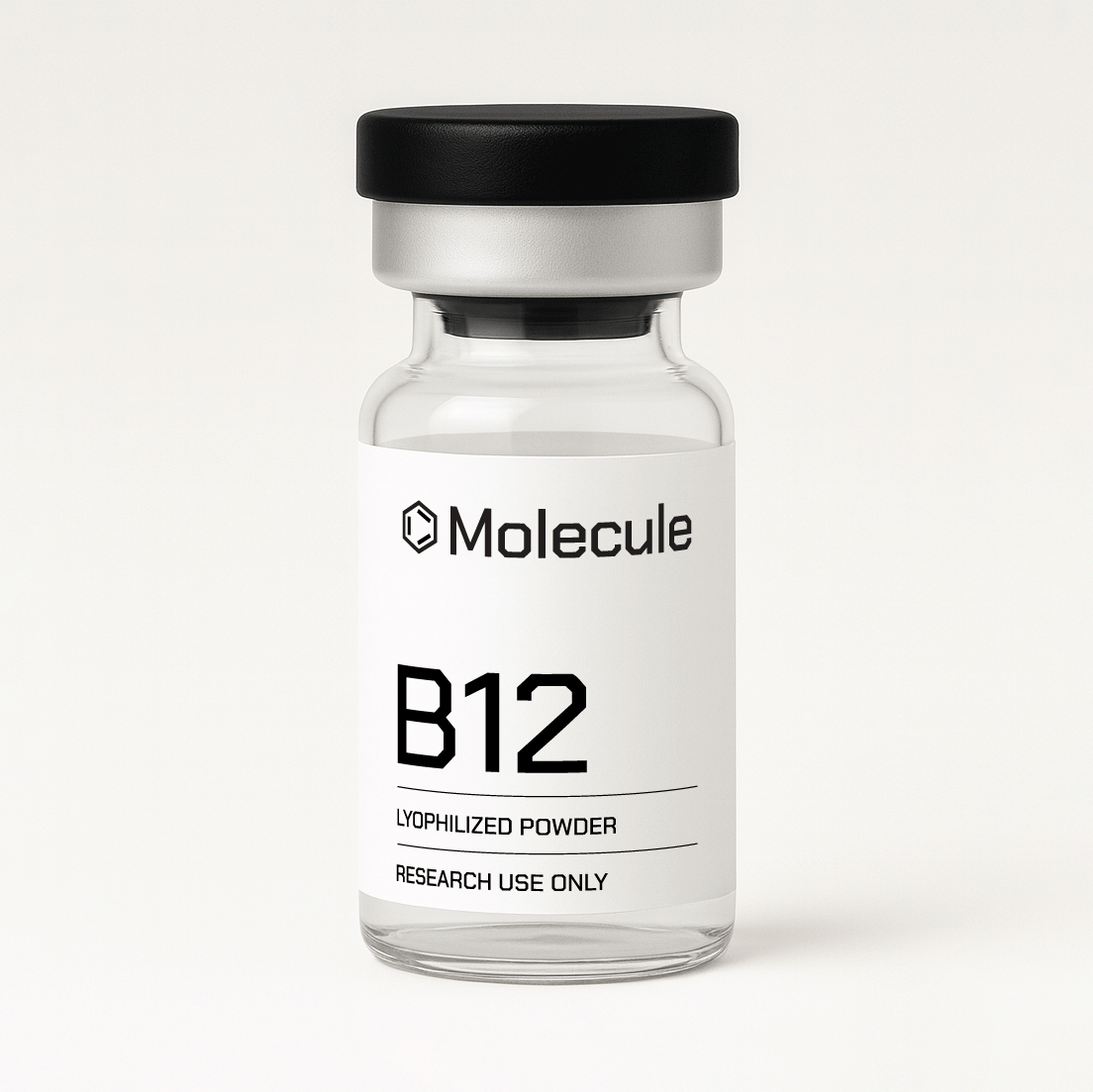
Description
Vitamin B12 (Cobalamin)
Water-Soluble Cofactor and Enzyme Modulator
Vitamin B12 (Cobalamin) is a water-soluble cobalt-containing compound that functions as a cofactor for enzymatic reactions in cellular metabolism. In laboratory and preclinical research, B12 is primarily studied as a biochemical tool to investigate methylation pathways, mitochondrial function, and intermediary metabolism.
B12 is a well‑established therapeutic vitamin in human and veterinary medicine. Experimental studies have explored B12’s role in methionine synthesis, homocysteine metabolism, and methylmalonyl-CoA conversion, as well as its involvement in cellular energy regulation and redox homeostasis. B12 is widely used in research on metabolic pathways, neurobiochemistry, and enzyme-catalyzed reactions, rather than for direct therapeutic outcomes.
Compound Identity and Molecular Profile
| Property | Description |
|---|---|
| Compound Name | Vitamin B12 |
| Full Name | Cobalamin |
| Compound Class | Water-soluble cofactor, enzyme modulator |
| Molecular Weight | ~1,355 Da (varies by derivative) |
| Molecular Formula | C₆₃H₈₈CoN₁₄O₁₄P |
| Primary Research Focus | Methylation reactions, mitochondrial metabolism, enzymatic cofactor studies |
Chemical and Registry Information
| Property | Value |
|---|---|
| CAS Number | 68-19-9 (Cyanocobalamin) |
| PubChem CID | 5280795 |
| Synonyms | Cyanocobalamin, Hydroxocobalamin, Methylcobalamin, Adenosylcobalamin |
| Structural Features | Corrin ring with central cobalt atom; multiple biologically active forms |
Biological Pathways Studied (Preclinical Research)
Vitamin B12 has been investigated for mechanistic activity within metabolic and enzymatic pathways:
| Pathway / System | Research Context |
|---|---|
| One-Carbon Metabolism | Studied as a cofactor in methionine synthase–dependent methylation reactions |
| Methylmalonyl-CoA Conversion | Explored in mitochondrial enzyme-mediated conversion to succinyl-CoA |
| Homocysteine Metabolism | Investigated in enzymatic regulation of homocysteine levels |
| Neurochemical Pathways | Examined for involvement in neuron-associated metabolic pathways in preclinical models |
| Energy and Redox Regulation | Explored in cellular energy metabolism and mitochondrial function studies |
Research Applications
Vitamin B12 is commonly used in laboratory research for:
-
Preclinical investigations of methylation and one-carbon pathways
-
Studies of mitochondrial metabolism and enzymatic cofactor activity
-
In vitro and animal models of intermediary metabolism
-
Investigations of neurochemical metabolic regulation
-
Oxidative stress and redox signaling assays
All applications of this product are restricted to in vitro and animal model research; B12 is not intended for human, veterinary, or therapeutic use.
Storage and Handling Guidelines
Vitamin B12 should be stored in a cool, dry environment, protected from light and oxidative conditions. Standard laboratory safety protocols should be observed to maintain chemical integrity and reproducibility in experimental research.
Lyophilized or Solid Form
B12 is often supplied in solid or lyophilized form, which preserves stability and allows for precise experimental dosing. This format facilitates reproducibility in controlled laboratory studies.
Shelf Life After Reconstitution
Following reconstitution, B12’s stability can vary based on solvent, pH, temperature, and exposure to light. Reconstituted solutions are generally suitable for short-term experimental use, and researchers should plan assays and storage conditions carefully to maintain reproducibility and data quality.