Description
GHK-Cu
Synthetic Peptide Research Tool
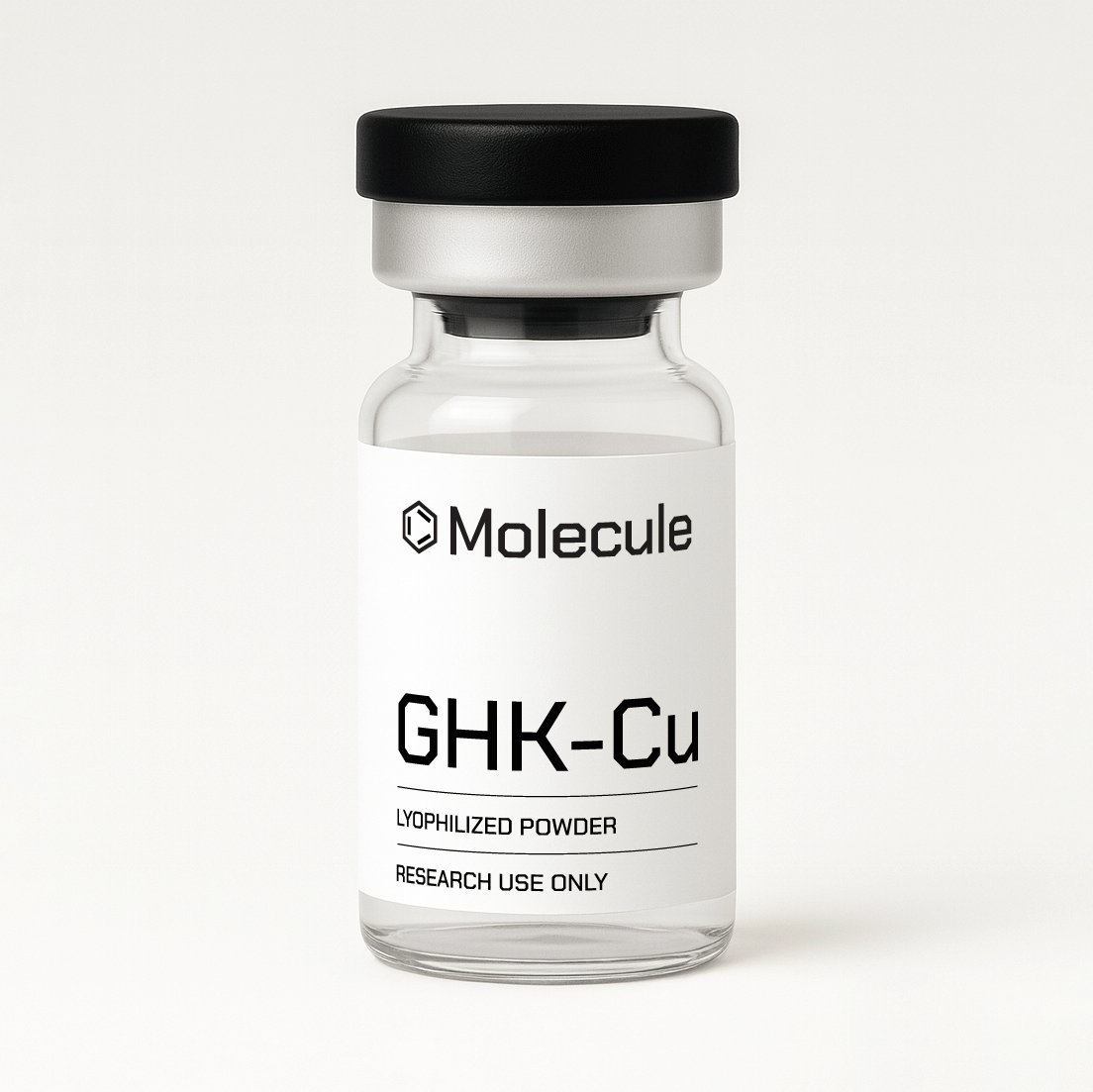
GHK-Cu (Glycyl-L-Histidyl-L-Lysine copper complex) is a synthetic tripeptide conjugated with copper, widely utilized in laboratory and preclinical studies to investigate cellular signaling, extracellular matrix regulation, and tissue biology.
Preclinical research explores GHK-Cu as a modulator of molecular pathways associated with metal ion-dependent signaling, gene expression, and enzymatic activity. Investigations typically focus on cellular repair models, matrix metalloproteinase regulation, and oxidative stress-related signaling, without implying therapeutic outcomes.
Peptide Identity and Molecular Profile
| Property | Description |
|---|---|
| Peptide Name | GHK-Cu |
| Peptide Class | Synthetic tripeptide–metal complex |
| Amino Acid Length | 3 residues (copper-complexed) |
| Peptide Sequence | Gly-His-Lys-Cu²⁺ |
| Molecular Weight | ~404 Da, copper‑complexed form |
| Biological Origin | Synthetic analog of naturally occurring human plasma tripeptide |
Chemical and Registry Information
| Property | Value |
|---|---|
| Molecular Formula | C₁₄H₂₄N₆O₄Cu |
| CAS Number | 49557-75-7 |
| PubChem CID | 5281809 |
| Synonyms | GHK-Cu, Glycyl-L-Histidyl-L-Lysine copper complex |
| Source Notes | Laboratory-grade, synthetic research peptide |
Biological Pathways Studied (Preclinical Research)
In preclinical and in vitro studies, GHK-Cu has been investigated for its interactions with cellular regulatory and metal-dependent signaling systems:
| Pathway / System | Research Context |
|---|---|
| Extracellular Matrix Modulation | Studied for influence on collagen, elastin, and matrix metalloproteinases |
| Copper-Dependent Signaling | Explored as a metal-peptide complex influencing enzymatic cofactor activity |
| Cellular Stress Response | Investigated for gene expression changes associated with oxidative stress pathways |
| Tissue Remodeling & Repair Models | Studied in fibroblast and epithelial cell models to assess matrix-related signaling |
| Gene Regulation Networks | Examined for transcriptional modulation of genes involved in proliferation, differentiation, and tissue structure |
Research Applications
GHK-Cu is commonly employed in laboratory research for:
-
Preclinical extracellular matrix and collagen regulation studies
-
Cellular assays for metal-dependent enzymatic activity
-
Fibroblast and epithelial tissue remodeling models
-
Investigations of gene expression and regulatory networks
-
In vitro studies of oxidative stress response and cellular signaling
Note: All applications are restricted to preclinical research and laboratory models. GHK-Cu is not intended for human or veterinary use.
Storage and Handling Guidelines
Store GHK-Cu in a cool, dry place, protected from light and moisture. Maintain standard laboratory storage conditions to preserve peptide stability. Handle using institutional laboratory safety protocols.
Lyophilized Powder
GHK-Cu is supplied as a lyophilized powder, produced through freeze-drying to minimize residual moisture while preserving peptide conformation and metal complex integrity. This format supports precise quantification and reproducibility in experimental settings.
Shelf Life After Reconstitution
Once reconstituted, GHK-Cu no longer retains the dry-state stability. Reconstituted material is generally suitable for short-term laboratory use, with stability influenced by solvent choice, storage temperature, and handling conditions. Laboratory planning should consider post-reconstitution stability as part of experimental design and data integrity management.
Compliance Notice
GHK-Cu is supplied exclusively for laboratory and preclinical research purposes. It is not intended for human, therapeutic, veterinary, or diagnostic applications. All handling must adhere to applicable regulatory, institutional, and safety guidelines.