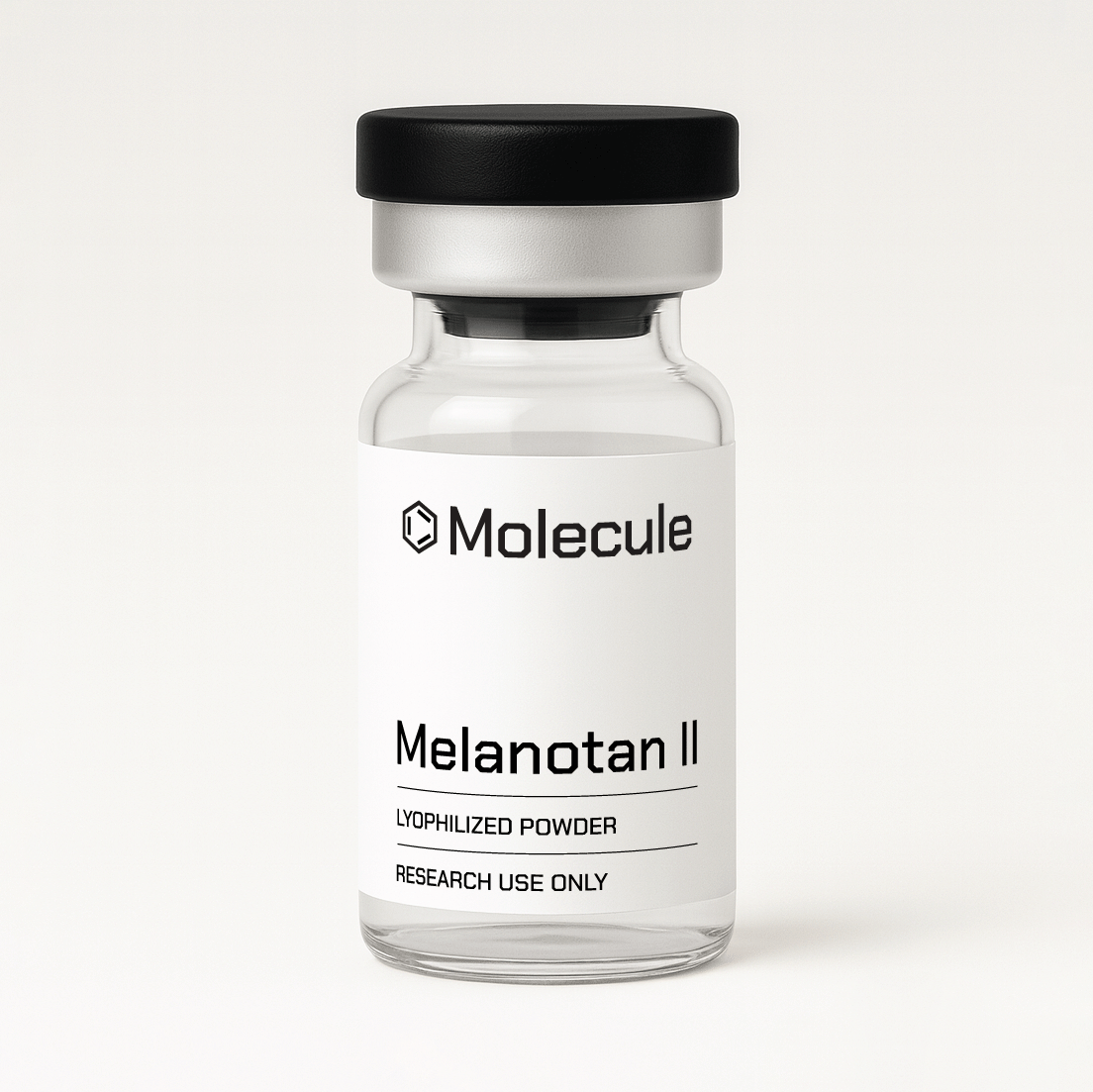
Melanotan II

Melanotan II is a synthetic peptide that may support enhanced tanning and skin pigmentation. Available in 10mg size.

$55.00

Size

10mg

Fast processing & shipping

Orders are processed and shipped within 1–2 business days to ensure timely delivery of research materials.

All sales final

Due to the nature of laboratory research materials, all sales are final once shipped. No returns or refunds on delivered items.

Limited refund eligibility

Refunds or replacements are only issued for incorrect, damaged, or undelivered orders. Claims must be submitted within 48 hours with supporting photos.

Description

Melanotan II

Synthetic Peptide Research Tool

Melanotan II is a synthetic cyclic heptapeptide analog of α-melanocyte-stimulating hormone (α-MSH). It is utilized in laboratory and preclinical research to study melanocortin receptor signaling, melanocyte biology, and related neuroendocrine pathways.

In preclinical studies, Melanotan II is investigated as a ligand for melanocortin receptors (MC1R, MC3R, MC4R, and MC5R), enabling exploration of intracellular signaling mechanisms, receptor activation dynamics, and downstream cyclic AMP (cAMP) pathways in cellular and animal models. Research focuses on molecular interactions, receptor-mediated signal transduction, and physiological response modeling, without implying therapeutic applications.


Peptide Identity and Molecular Profile

Property Description
Peptide Name Melanotan II
Peptide Class Synthetic cyclic peptide, α-MSH analog
Amino Acid Length 7 residues (cyclic heptapeptide)
Peptide Sequence Ac-Nle-cyclo[Asp-His-D-Phe-Arg-Trp-Lys]-NH₂
Molecular Weight 1025.2 Da
Biological Origin Synthetic analog of endogenous α-MSH

Chemical and Registry Information

Property Value
Molecular Formula C₅₀H₆₁N₁₁O₈
CAS Number 121062-08-6
PubChem CID 16132784
Synonyms MT-II, Melanotan II, Ac-Nle-cyclo[Asp-His-D-Phe-Arg-Trp-Lys]-NH₂
Source Notes Synthetic, laboratory-grade, research-use peptide

Biological Pathways Studied (Preclinical Research)

In laboratory and preclinical research, Melanotan II has been investigated for mechanistic interactions with melanocortin receptors and downstream signaling pathways, including:

Pathway / System Research Context
Melanocortin Receptor Signaling (MC1R–MC5R) Studied for G-protein coupled receptor activation and cAMP-mediated intracellular cascades
cAMP/PKA Pathway Investigated for receptor-mediated second messenger effects
Pigmentation Pathways Explored in melanocyte models for melanin synthesis signaling
Neuroendocrine Regulatory Networks Examined for hypothalamic and central melanocortin system interactions
Energy Homeostasis & Appetite Signaling Studied in preclinical animal models to assess melanocortin receptor modulation

Research Applications

Melanotan II is commonly employed in laboratory research for:

  • In vitro and in vivo melanocortin receptor signaling studies

  • Preclinical melanocyte biology investigations

  • Neuroendocrine network and central melanocortin system research

  • Signal transduction analyses of cAMP-mediated pathways

  • Comparative peptide receptor binding studies

Note: All applications are restricted to preclinical research and laboratory studies. Melanotan II is not intended for human or veterinary use, and research should comply with all relevant safety regulations.


Storage and Handling Guidelines

Store Melanotan II in a cool, dry environment, protected from light. Maintain laboratory-standard storage conditions to preserve peptide integrity. Handle using institutional laboratory safety protocols.


Lyophilized Powder

Melanotan II is provided as a lyophilized powder, produced via freeze-drying to remove moisture while preserving peptide conformation. Lyophilization supports accurate dosing in research studies and reproducibility in controlled experimental setups.


Shelf Life After Reconstitution

Following reconstitution, Melanotan II is no longer in its lyophilized state. Stability is influenced by solvent, storage temperature, and handling conditions. Reconstituted material is generally suitable for short-term laboratory use, with stability considerations incorporated into experimental planning. Actual usable duration may vary depending on research-specific environmental factors.


Compliance Notice

Melanotan II is supplied exclusively for laboratory and preclinical research. It is not intended for human, therapeutic, veterinary, or diagnostic use. Purchasers must adhere to all applicable regulatory, safety, and institutional guidelines for handling research peptides.

Melanotan II Research Overview

Melanotan II (MT‑II) is a synthetic cyclic peptide analog of alpha-melanocyte-stimulating hormone (α-MSH). It has been investigated in laboratory and preclinical studies to explore melanocortin receptor signaling pathways and neuroendocrine regulation (Hadley & Dorr, 2006). MT‑II interacts with multiple melanocortin receptor subtypes, making it a tool compound for research into pigmentation biology, appetite signaling, and central melanocortin system function (Cone, 2005).

MT‑II is chemically stabilized relative to endogenous α-MSH, allowing prolonged receptor engagement in vitro and in animal models (Hadley & Dorr, 2006). Preclinical research often employs MT‑II to probe structure–activity relationships among melanocortin receptor subtypes, without implying therapeutic effects.

Molecular Formula: C₅₀H₆₉N₁₅O₉ (Wikipedia, 2025)


Mechanism of Action in Laboratory Models

Melanotan II functions primarily as a non-selective agonist of melanocortin receptors, which are part of the G protein–coupled receptor (GPCR) family:

  • MC1R – MT‑II has been studied for receptor engagement in melanocytes, where α-MSH pathways regulate melanin synthesis (Cone, 2005).

  • MC3R and MC4R – In rodent models, MT‑II has been investigated for effects on feeding behavior and hypothalamic appetite signaling (Weninger et al., 2003).

  • Multi-receptor engagement – MT‑II binds several melanocortin receptor subtypes (MC1R, MC3R, MC4R, MC5R) and is used to explore receptor selectivity and intracellular signaling cascades in vitro (Hadley & Dorr, 2006).

Laboratory studies typically monitor intracellular second messengers (e.g., cAMP) or gene expression changes downstream of receptor activation to evaluate MT‑II’s effects.


Primary Research Findings

Research with MT‑II spans preclinical pharmacology, in vitro assays, and animal behavior models:

  • Receptor Pharmacology – The cyclic peptide structure enhances stability and receptor affinity compared with linear α-MSH fragments, supporting prolonged melanocortin receptor engagement (Hadley & Dorr, 2006).

  • Pigmentation Biology – MT‑II has been investigated for MC1R-mediated melanin synthesis in melanocyte cultures and rodent models, enabling study of melanogenic pathways independently of UV exposure (Cone, 2005).

  • Appetite Regulation – In rodent studies, MT‑II administration to the nucleus accumbens or hypothalamus has been shown to reduce food intake and alter motivated feeding behavior, providing insight into central melanocortin control of energy balance (Weninger et al., 2003).

  • Neurobiology – MT‑II has been explored in peripheral nerve injury models for potential neurotrophic signaling effects, including observations of neuronal survival and functional recovery in rodents (Hadley & Dorr, 2006).

  • Sexual Behavior Research – MT‑II has been used in human experimental contexts to examine melanocortin-mediated sexual arousal pathways, primarily for mechanistic understanding rather than therapeutic assessment (Hadley & Dorr, 2006).


System-Specific Research Applications

Pigmentation and Melanocyte Biology

Laboratory research often investigates:

  • MC1R receptor activation and downstream melanogenic enzyme expression

  • Melanin production pathways in melanocyte cultures

  • Effects on melanocyte signaling independent of environmental UV exposure (Cone, 2005)

Appetite and Energy Regulation

Preclinical feeding models explore:

  • Hypothalamic and accumbens melanocortin receptor pathways

  • POMC-derived peptide interactions and downstream appetite signaling (Weninger et al., 2003)

Neurobiology and Peripheral Nerve Research

Research investigations include:

  • Neuronal survival signaling in peripheral nerve injury models

  • Melanocortin receptor involvement in tissue-level neurotrophic pathways (Hadley & Dorr, 2006)


Comparative Research Context

MT‑II is commonly studied alongside Melanotan I (afamelanotide) and other α-MSH analogs to investigate receptor subtype selectivity, ligand stability, and intracellular signaling differences (Hadley & Dorr, 2006). Comparative studies are presented in a mechanistic research context, without suggesting superior efficacy or clinical benefits.


Research Handling and Format

  • Lyophilized Powder – MT‑II is typically supplied as freeze-dried powder, which supports stability, accurate dosing in vitro, and reproducibility in experimental protocols.

  • Storage Recommendations – Store in a cool, dry environment and protect from light and moisture. Follow standard laboratory safety protocols.

  • Experimental Preparation – Reconstitution is done under controlled conditions; stability post-reconstitution may vary and should be considered in experimental planning.


Research Use Only Disclaimer

This compound is intended solely for laboratory research purposes. It is not for human consumption, clinical use, therapeutic application, or veterinary use. Investigators must comply with all institutional and regulatory guidelines when handling synthetic research peptides.


References


Melatonan II COA

Related products

Disclaimer: For Research Purposes Only

The owner of this website has made a commitment to accessibility and inclusion, please report any problems that you encounter using the contact form on this website. This site uses the WP ADA Compliance Check plugin to enhance accessibility.
0
    0
    Your Cart
    Your cart is emptyReturn to Shop