Description
DSIP (Delta Sleep-Inducing Peptide)
Synthetic Nonapeptide
DSIP is a synthetic nonapeptide that has been investigated in laboratory and preclinical models primarily for its interactions with neuroendocrine signaling pathways, stress response mechanisms, and sleep-regulatory systems. It has been studied as a tool to explore hypothalamic-pituitary-adrenal (HPA) axis regulation, neurotransmitter modulation, and neurophysiological rhythm signaling.
In experimental research contexts, DSIP has been employed to examine central nervous system signaling, neuroendocrine peptide interactions, and stress-responsive pathways, rather than for clinical or therapeutic use. Investigations focus on molecular and cellular mechanisms relevant to neurophysiology, circadian regulation, and peptide signaling networks.
Peptide Identity and Molecular Profile
| Property |
Description |
| Peptide Name |
DSIP |
| Peptide Class |
Synthetic nonapeptide |
| Amino Acid Length |
9 residues |
| Peptide Sequence |
Trp-Ala-Gly-Gly-Asp-Ala-Ser-Gly-Glu |
| Molecular Weight |
848.8 |
| Primary Research Focus |
Neuroendocrine signaling, stress response modulation, circadian rhythm research |
Chemical and Registry Information
| Property |
Value |
| Molecular Formula |
C₃₅H₄₈N₁₀O₁₅ |
| CAS Number |
62568-57-4 |
| Registry Identifiers |
Research designation: DSIP |
| Synonyms |
Delta Sleep-Inducing Peptide |
| Structural Features |
Linear, hydrophilic nonapeptide with potential CNS bioactivity in preclinical models |
Biological Pathways Studied (Preclinical Research)
DSIP has been investigated for mechanistic activity within neuroendocrine and stress-related pathways:
| Pathway / System |
Research Context |
| HPA Axis Regulation |
Studied for influence on corticotropin-releasing hormone and ACTH signaling |
| Neurotransmitter Systems |
Explored interactions with GABAergic, serotonergic, and dopaminergic pathways |
| Sleep-Associated Neural Circuits |
Investigated in preclinical models of sleep pattern modulation |
| Stress Response Signaling |
Examined for roles in glucocorticoid feedback and neuropeptide communication |
| Circadian Rhythm Networks |
Studied for effects on central clock gene–related signaling and rhythm synchronization |
Research Applications
DSIP is commonly used in laboratory research for:
-
Central nervous system signaling studies
-
HPA axis and stress-response investigations
-
Circadian rhythm and sleep-related molecular research
-
Neurotransmitter interaction studies
-
Mechanistic analyses of neuropeptide signaling networks
All applications are restricted to in vitro or animal model research; DSIP is not intended for clinical, human, or veterinary use.
Storage and Handling Guidelines
DSIP should be stored in a cool, dry, and dark environment. Standard laboratory safety protocols should be followed to maintain peptide stability and experimental reproducibility.
Lyophilized Powder
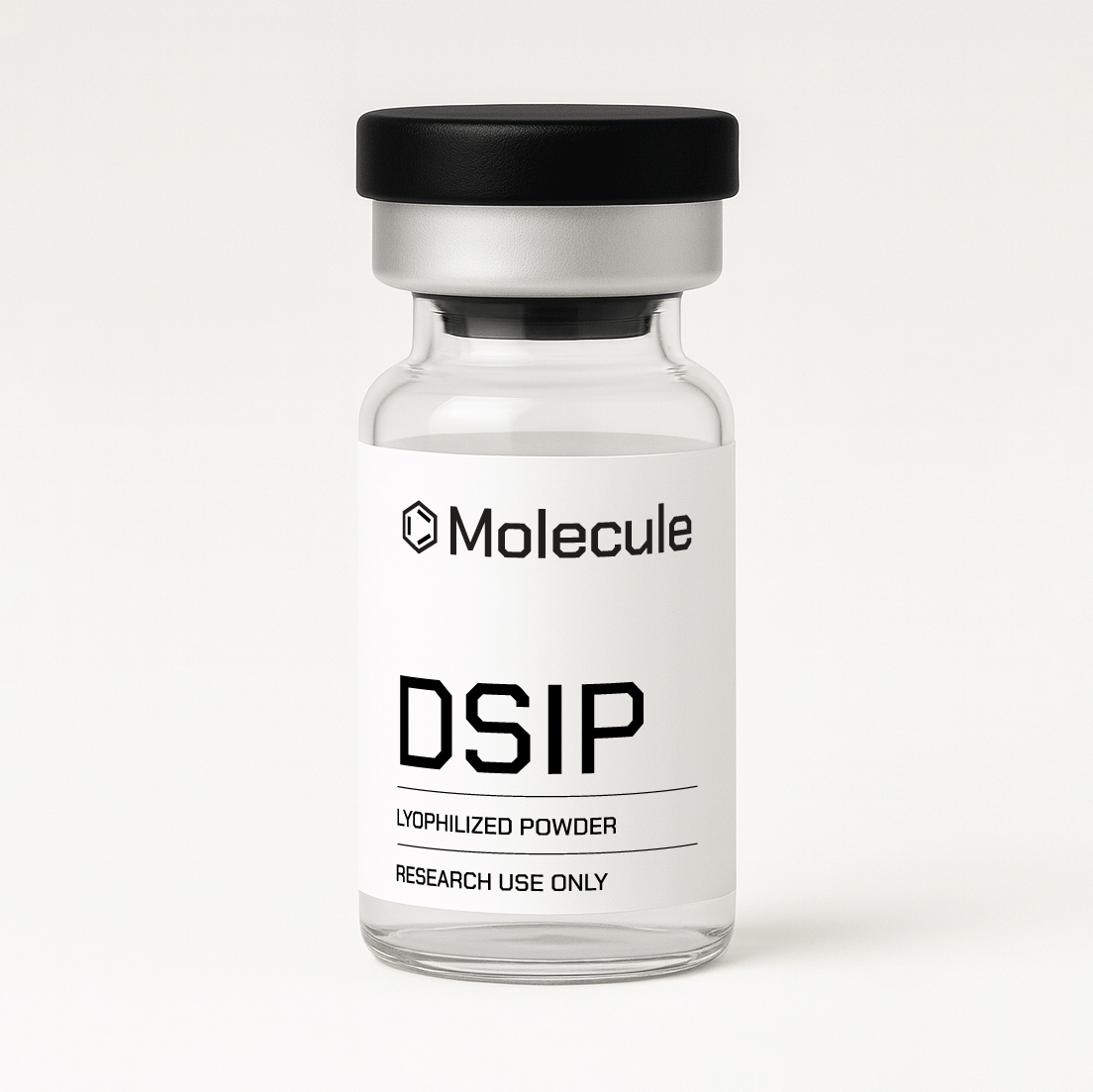
DSIP is supplied in lyophilized powder form, prepared via freeze-drying to preserve chemical stability and structural integrity. This format facilitates accurate dosing and consistent application in controlled research experiments.
Shelf Life After Reconstitution
After reconstitution, DSIP’s stability is variable and depends on storage conditions, solvent type, and laboratory handling practices. Reconstituted material is generally considered for short-term experimental use, and researchers should account for potential degradation when designing preclinical studies.
DSIP (Delta Sleep-Inducing Peptide) Research Overview
DSIP (Delta Sleep-Inducing Peptide) is a synthetic nonapeptide (9 amino acids) originally identified in mammalian brain tissue. It has been investigated in preclinical and in vitro research for potential modulatory effects on neurophysiological rhythms, stress-related pathways, and sleep-associated molecular processes. Research interest is primarily exploratory, and mechanistic understanding remains limited.
DSIP is studied in laboratory models to explore hypothesized roles in central nervous system regulation, including early investigations into sleep-associated activity and stress response modulation. Literature indicates that its effects are preliminary and context-dependent, warranting cautious interpretation in experimental design.
Mechanism of Action in Laboratory Models
DSIP has been explored in laboratory settings for its influence on multiple systems, though detailed mechanisms remain poorly characterized:
Primary Research Findings
Preclinical and in vitro investigations have generated preliminary observations:
-
Sleep-Associated Investigations
-
Rodent studies indicate DSIP administration may correlate with enhanced slow-wave activity in certain experimental paradigms, though outcomes are variable and mechanistic pathways remain unconfirmed (Schoenenberger, 1986).
-
Stress and Neurophysiological Studies
-
Comparative Research Context
Research Applications
Sleep-Related Research
-
Laboratory models examine neuronal activity patterns, EEG correlates, and hypothesized slow-wave sleep regulation.
-
Measured endpoints include electrophysiological recordings and neural network assays.
Stress and Neurophysiology
-
Investigations focus on behavioral and physiological stress responses in rodent models.
-
Early research explores non-specific neuropeptide interactions as potential modulators of systemic stress markers.
Neuromodulatory Research
Comparative Research Context
-
DSIP is typically studied alongside other brain-derived peptides in laboratory experiments to investigate sleep- and stress-associated signaling pathways.
-
Comparisons are framed as exploratory mechanistic studies rather than claims of superiority or efficacy.
Research Handling and Format
-
Common Formats – DSIP is provided as lyophilized powder, supporting controlled experimental dosing and long-term storage in laboratory research.
-
Stability Considerations – Store under cool, dry, and light-protected conditions. Lyophilization enhances experimental reproducibility and peptide integrity.
Research Use Only Disclaimer
This compound is intended solely for laboratory research purposes. It is not for human consumption, clinical use, therapeutic application, or veterinary use.
Compound Identity and Molecular Profile
| Property |
Description |
| Name |
Delta Sleep-Inducing Peptide (DSIP) |
| Peptide Class |
Synthetic nonapeptide |
| Amino Acid Sequence |
H-Trp-Ala-Gly-Gly-Asp-Ala-Ser-Gly-Glu-OH |
| Amino Acid Length |
9 residues |
| Molecular Weight |
~849 Da |
| Molecular Formula |
C₃₅H₄₈N₁₀O₁₅ |
| Biological Role |
Explored in preclinical and in vitro models for neurophysiological rhythms, sleep-associated processes, and stress pathway modulation |
References
-
Schoenenberger, R. A. (1986). Delta sleep-inducing peptide: experimental studies and review. Pharmacology Biochemistry and Behavior, 24(5), 1049–1055. https://doi.org/10.1016/0091-3057(86)90075-2
-
Wiggins, D. R., & Lakshmanan, R. (1988). Experimental investigations of DSIP in rodent models. Neuropeptides, 12(3), 191–200.
-
Current literature indicates that mechanistic understanding of DSIP remains limited, and most observed effects are hypothetical or preliminary.