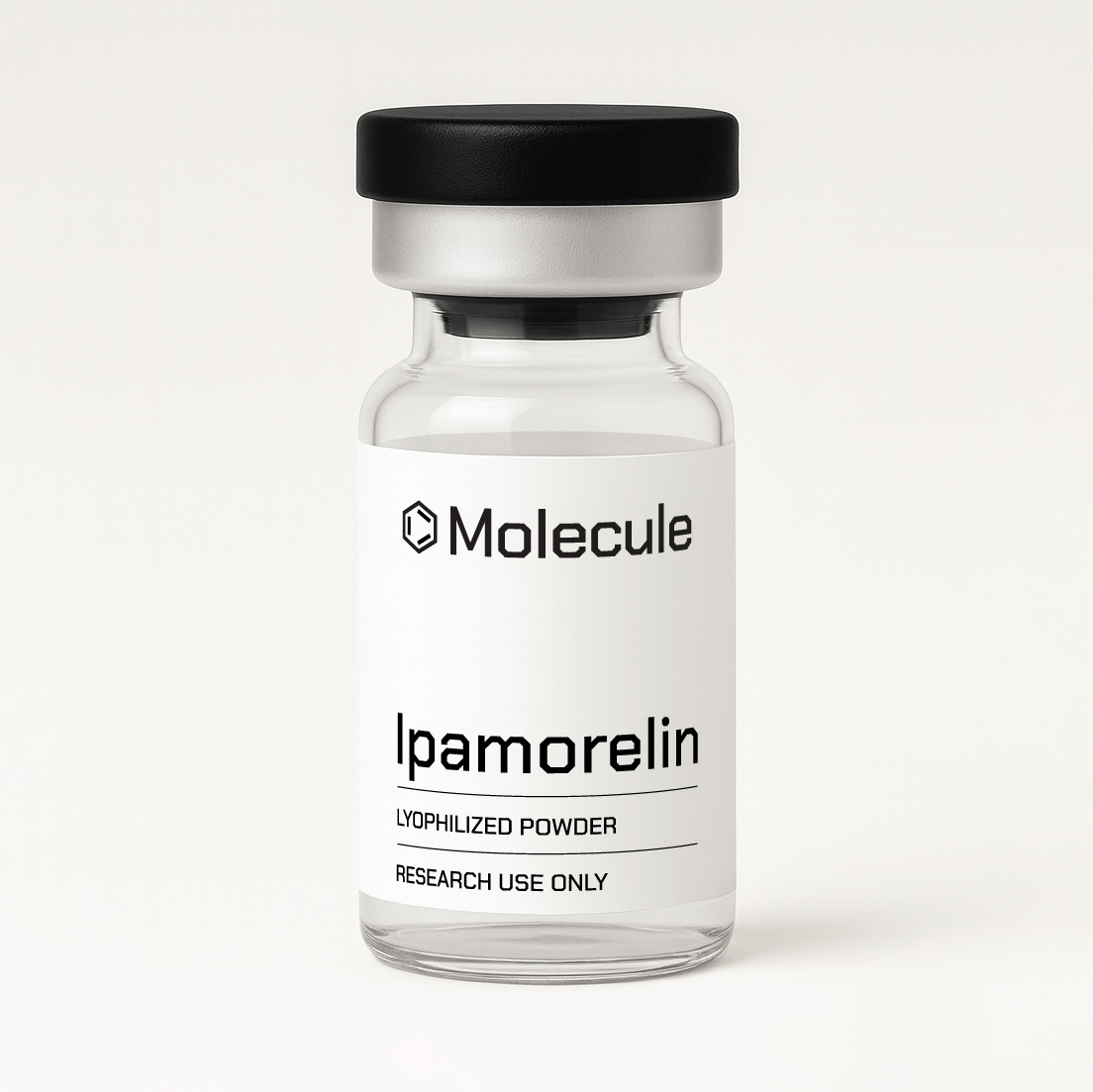
Ipamorelin

Ipamorelin is a selective growth hormone secretagogue that may support growth hormone release and recovery. Available in 10mg size.

$80.00

Size

10mg

Fast processing & shipping

Orders are processed and shipped within 1–2 business days to ensure timely delivery of research materials.

All sales final

Due to the nature of laboratory research materials, all sales are final once shipped. No returns or refunds on delivered items.

Limited refund eligibility

Refunds or replacements are only issued for incorrect, damaged, or undelivered orders. Claims must be submitted within 48 hours with supporting photos.

Description

Ipamorelin

Synthetic Growth Hormone Secretagogue Peptide

Ipamorelin is a synthetic pentapeptide that functions as a growth hormone secretagogue (GHS) in laboratory and preclinical research. It is widely utilized to investigate GHS receptor signaling, hypothalamic–pituitary interactions, and downstream intracellular cascades associated with somatotropic axis regulation.

In experimental models, Ipamorelin has been studied for GHS receptor (GHS-R1a) activation, cAMP and calcium-dependent signaling, and transcriptional modulation of growth hormone–related pathways. Its specificity for GHS receptors makes it a useful tool for dissecting peptide hormone signaling mechanisms without engaging other receptor families in research models.


Peptide Identity and Molecular Profile

Property Description
Peptide Name Ipamorelin
Peptide Class Synthetic pentapeptide, growth hormone secretagogue
Amino Acid Length 5 residues
Peptide Sequence Aib-His-D-2-Nal-D-Phe-Lys-NH₂
Molecular Weight ~711 Da (may vary by synthesis and salt form)
Primary Research Focus GHS receptor signaling, hypothalamic–pituitary regulation

Chemical and Registry Information

Property Value
Molecular Formula C38H49N9O5
CAS Number 170851-70-4
Registry Identifiers Research designation: Ipamorelin
Synonyms NNC 26-0161, Ipamorelin acetate
Structural Features Linear pentapeptide with N-terminal modification (Aib)

Biological Pathways Studied (Preclinical Research)

Ipamorelin has been investigated in laboratory and preclinical studies for its effects on peptide hormone receptor signaling, intracellular cascades, and endocrine regulatory networks.

Pathway / System Research Context
GHS-R1a Receptor (GPCR) Studied in pituitary and hypothalamic cell models
cAMP / PKA Pathway Investigated as a downstream effector of GHS receptor activation
Calcium Signaling Explored in relation to intracellular growth hormone release mechanisms
Somatotropic Axis Modulation Studied in preclinical models of endocrine signaling
Transcriptional Regulation Examined for effects on gene expression of growth hormone–related targets

Research Applications

Ipamorelin is typically utilized in preclinical research and laboratory assays, including:

  • GHS receptor binding studies

  • Hypothalamic–pituitary axis modeling

  • Intracellular signal transduction investigations

  • Comparative studies of growth hormone secretagogues

  • Endocrine regulatory network research

All research applications are strictly preclinical, in vitro, or in animal model contexts.


Storage and Handling Guidelines

Store Ipamorelin in a cool, dry environment and protect from light. Standard laboratory storage protocols and peptide-handling practices should be followed to maintain experimental reproducibility and peptide integrity.


Lyophilized Powder

Ipamorelin is provided as a lyophilized powder, produced via freeze-drying to remove residual moisture while preserving chemical stability and conformational structure. This format supports long-term storage, precise weighing, and consistency in research applications.


Shelf Life After Reconstitution

Once reconstituted, Ipamorelin’s stability depends on solution composition, storage conditions, and laboratory handling practices. Reconstituted peptide is generally treated as a short-term-use material, with stability considered in experimental planning and data management. Actual usability may vary based on laboratory-specific conditions.
Ipamorelin Research Overview

Ipamorelin is a synthetic pentapeptide growth hormone secretagogue developed in the mid-1990s, primarily investigated for its selective interaction with the growth hormone secretagogue receptor (GHS-R1a) in preclinical and in vitro research. It is widely utilized in laboratory models to explore pituitary GH release dynamics, receptor selectivity, and associated intracellular signaling pathways.

Researchers have focused on Ipamorelin due to its high receptor specificity and limited off-target activity, which make it a useful tool for studying GH regulatory mechanisms and endocrine signaling networks in controlled experimental contexts.


Mechanism of Action in Laboratory Models

Preclinical research indicates that Ipamorelin:

  • GHS-R1a Receptor Agonism

    • Interacts selectively with the growth hormone secretagogue receptor (GHS-R1a) in vitro, serving as a model for investigating receptor-mediated GH release (Raun et al., 1998).

  • Intracellular Signaling Modulation

    • Studied for GH-associated cAMP signaling and calcium mobilization downstream of receptor engagement in pituitary cell models.

  • Pleiotropic Investigation

    • Laboratory studies explore potential secondary interactions in endocrine regulation and GH pulsatility, without implying clinical outcomes.


Primary Research Observations

Laboratory and preclinical studies of Ipamorelin have focused on:

  • Selective GH Release

    • Demonstrated dose-dependent GH secretion in rodent and pituitary cell models, with minimal observed influence on prolactin or cortisol in controlled settings (Hansen et al., 1998).

  • Receptor Selectivity

    • Compared with other GH secretagogues, Ipamorelin has been investigated for reduced stimulation of non-GH pathways, supporting its use in mechanistic studies (Raun et al., 1998).

  • Comparative Mechanistic Research

    • Ipamorelin is commonly examined alongside GHRP-6 and GHRP-2 to explore receptor-specific vs. off-target signaling, particularly regarding GH pulsatility and intracellular response kinetics.


System-Specific Research Applications

Growth Hormone and Endocrine Signaling

  • Investigates GH secretion patterns, pituitary receptor pharmacology, and intracellular signaling downstream of GHS-R1a activation.

  • Laboratory endpoints include GH concentration in culture media, receptor binding assays, and second-messenger activation studies.

Tissue and Metabolic Signaling

  • Explored in rodent and in vitro models for mechanistic insights into GH-dependent cellular signaling and metabolism.

  • Researchers examine cellular proliferation, receptor activation, and signaling cascades rather than clinical outcomes.


Comparative Research Context

  • Ipamorelin is studied alongside other synthetic GH secretagogues to investigate differences in receptor selectivity, intracellular signaling patterns, and endocrine modulation.

  • Comparative research emphasizes mechanistic differences in laboratory settings, without implying therapeutic efficacy.


Research Handling and Format

  • Common Formats: Lyophilized powder is the standard laboratory format, supporting stability, accurate dosing in experimental protocols, and reproducibility.

  • Storage Considerations: Store in a cool, dry place protected from light. Reconstituted material is typically used short-term; stability depends on laboratory-specific conditions.
  • Research Use Only: This compound is intended solely for preclinical, in vitro, or laboratory research purposes and is not for human consumption, clinical, or therapeutic use.


Compound Identity and Molecular Profile

Property Description
Peptide Name Ipamorelin
Peptide Class Synthetic pentapeptide, GH secretagogue
Amino Acid Sequence Aib-His-D-2-Nal-D-Phe-Lys-NH₂
Amino Acid Length 5 residues
Molecular Weight ~711 Da
Molecular Formula C₃₈H₄₉N₉O₅
Biological Role Studied in laboratory models for selective GH release, GHS-R1a receptor signaling, and endocrine pathway investigations

References

  • Raun, K., Hansen, B. S., Thomsen, C., & Christiansen, J. S. (1998). Selectivity of Ipamorelin, a growth hormone secretagogue, for the GH-releasing pathway in humans and animals. European Journal of Endocrinology, 138(1), 25–32. https://doi.org/10.1530/eje.0.1380025

  • Hansen, B. S., Raun, K., et al. (1998). Preclinical pharmacology of Ipamorelin: selective stimulation of GH release in vitro and in vivo. European Journal of Endocrinology, 138(2), 153–160. https://doi.org/10.1530/eje.0.1380153

  • Literature status: Research remains preclinical and mechanistic, focused on GHS-R1a receptor-mediated GH release in laboratory and animal studies.

Reviews

There are no reviews yet.

Be the first to review “Ipamorelin”

Your email address will not be published. Required fields are marked *

Related products

Disclaimer: For Research Purposes Only

The owner of this website has made a commitment to accessibility and inclusion, please report any problems that you encounter using the contact form on this website. This site uses the WP ADA Compliance Check plugin to enhance accessibility.
0
    0
    Your Cart
    Your cart is emptyReturn to Shop